If you’ve spent any time remodeling bathrooms in South Florida, you already know the challenge. The square footage is tight, the humidity is relentless, and homeowners want their bathrooms to look like something out of a design magazine — while still holding two people’s worth of towels, skincare, and blow dryers. That’s a tall order in a small space.
The good news? Vertical space is the most underused storage asset in almost every bathroom I walk into. Most people are thinking about counter space, floor cabinets, and vanity drawers. They’re not looking up. Once you start designing storage that climbs the walls instead of eating floor space, the whole room transforms — functionally and visually.
Let’s dig into exactly how to do that in Boca Raton homes, where the climate, the architecture, and the lifestyle all shape what works best.
Why Vertical Storage Is a Game-Changer in Florida Bathrooms
Here in Boca Raton, a lot of the homes were built in the ’80s and ’90s — and those bathroom footprints weren’t generous. Even in newer builds, bathrooms over 100 square feet are still considered large. So when you’re working with 60 or 70 square feet and a client wants storage for everything from guest towels to a full skincare routine, you have to get creative.
Vertical storage solutions work because they don’t compete with the floor plan. A floor cabinet eats square footage. A tall wall cabinet or a recessed niche doesn’t. It uses dead space — those blank stretches of drywall between fixtures and above the toilet — and turns them into functional storage.
There’s also a visual benefit. Vertical lines make a bathroom feel taller and less boxed-in. In Florida bathrooms that often lack windows or natural light, height draws the eye upward and opens the space.
Custom Cabinetry: The Most Versatile Storage Solution You Can Invest In
Off-the-shelf cabinets have their place, but they’re designed for average spaces. Custom cabinetry is designed for your space — your ceiling height, your wall dimensions, your plumbing layout. That distinction matters more in a bathroom than almost anywhere else in the house.
Floor-to-Ceiling Cabinetry
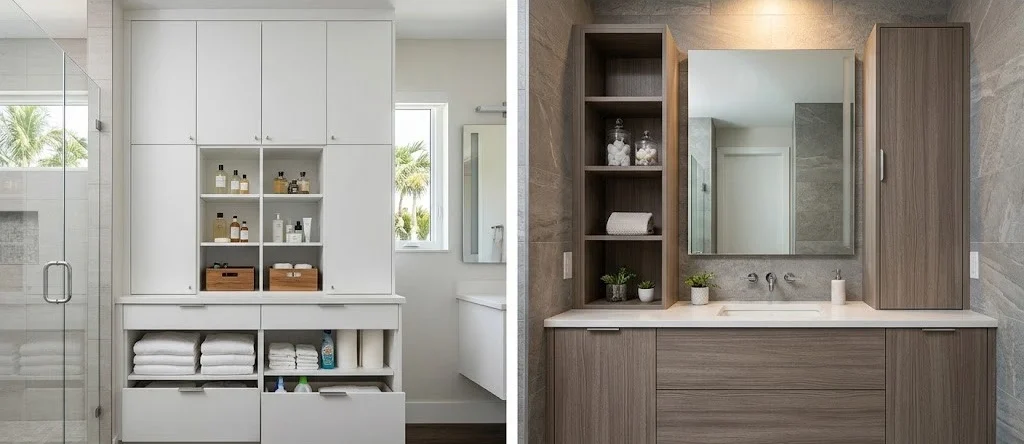
The single biggest storage upgrade I recommend in compact Florida bathrooms is going floor to ceiling with cabinetry on at least one wall. This works especially well on the wall opposite the shower or alongside the vanity.
A floor-to-ceiling cabinet in a bathroom typically breaks down into three functional zones. The lower section holds bulky items — extra toilet paper, cleaning supplies, spare towels. The middle section, at eye level, holds everyday items like medications, toiletries, and hair tools. The top section stores things you don’t need often — backup products, seasonal items, guest supplies.
When you use custom cabinetry, you can design each zone with the right shelf depth and height for exactly what goes in it. That sounds minor, but it makes a real difference. A shelf that’s 8 inches deep for toiletries won’t have bottles falling over or wasted empty space behind them.
Built-In Linen Towers
Linen towers are a narrower variation of floor-to-ceiling storage, and they’re perfect for Boca Raton bathrooms with limited wall runs. You can tuck a 12- to 18-inch-wide tower into almost any layout — beside the toilet, at the end of a double vanity, or flanking a window.
What makes them especially useful here is the way they handle towel storage. Florida living means wet swimwear, beach towels, gym towels, and regular bath towels all coexisting in the same bathroom. A linen tower with adjustable shelves and a few hooks on the side handles all of that without the chaos.
For materials, I steer clients in coastal climates toward moisture-resistant options. Thermofoil, painted MDF with a sealed finish, or PVC-based cabinetry all hold up better than wood veneer in a humid bathroom environment. If you want a wood look, go for a wood-grain thermofoil or a sealed, painted finish over marine-grade plywood.
Floating Vanity Cabinets with Tall Upper Towers
One layout I use often in medium-sized Boca Raton bathrooms is a floating vanity below with tall upper storage towers on either side of the mirror. You get the open feel of a floating design — which makes the floor look larger — while gaining significant vertical storage overhead.
The towers flanking the mirror can include shelves, drawers, or even integrated lighting. Some clients use one side for open shelving with curated products and decorative items, and the other as a closed cabinet for everything else. That combination keeps the space looking intentional rather than cluttered.
Recessed Niches: Built-In Storage That Disappears into the Wall
Niches are one of my favorite storage solutions in a well-designed bathroom. Done right, they look completely intentional — like the room was built around them. Done wrong, they look like someone cut a hole in the wall and hoped for the best.
The key is planning them early, ideally during a renovation before the drywall goes up.
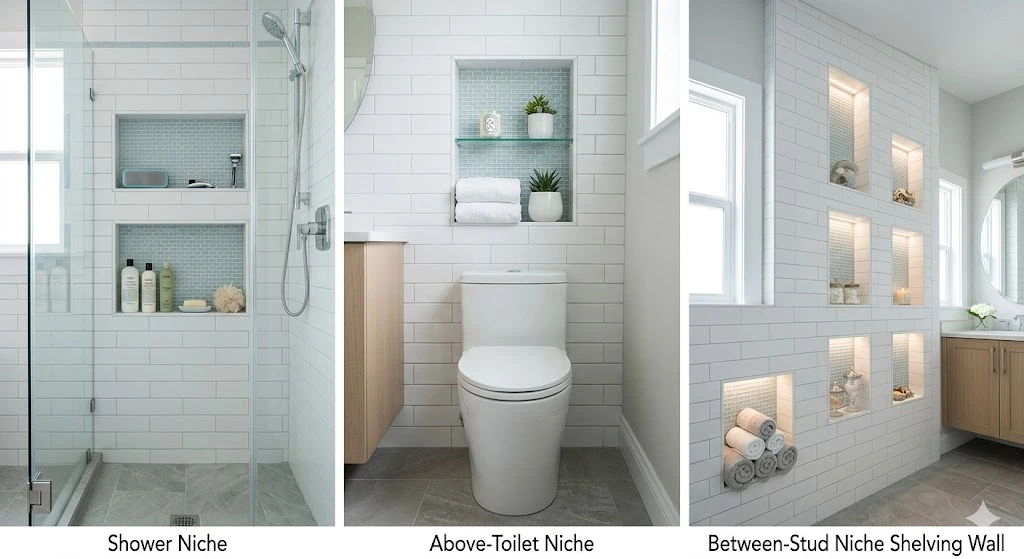
Shower Niches
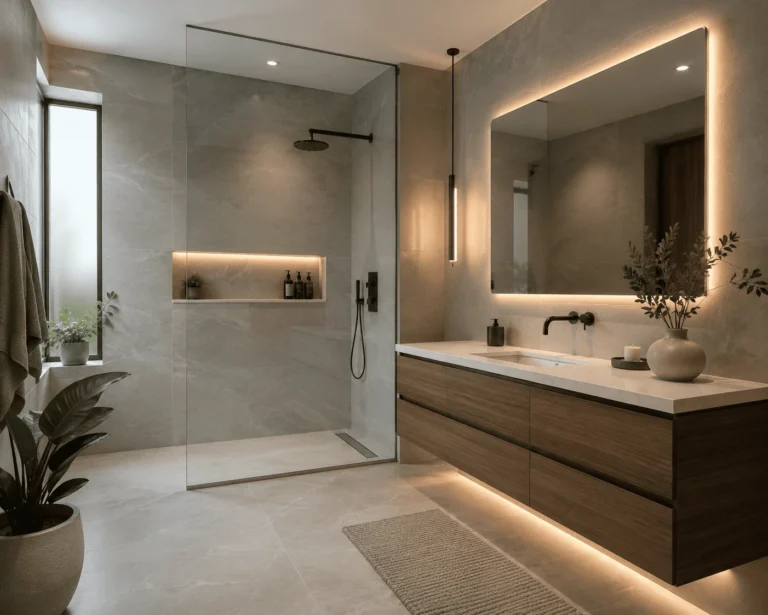
The shower niche is the most common, and for good reason. It keeps shampoo, conditioner, and body wash off the floor and off a wire caddy that inevitably gets rusty and falls over. A well-placed shower niche is one of those features that every client ends up loving after the fact, even if they weren’t sure about it during planning.
In Florida bathrooms, I size shower niches a bit larger than the national average — typically 12 by 24 inches at minimum. Clients here often have a larger product collection, or they use the niche to store shower speakers, razors, and loofahs along with their products. A double niche, stacked vertically, doubles that capacity without taking up any additional floor space.
For finish, I match the niche tile to the shower surround more often than not. It creates a clean, built-in look. When clients want a statement, we use a contrasting tile or a mosaic insert on the back wall of the niche — it reads as a design feature rather than a storage solution.
Above-Toilet Niches
The wall above the toilet is wasted space in most bathrooms. It’s typically blank, and it’s too far above the fixture to use comfortably as a shelf without looking awkward.
A recessed niche at that height solves the problem. You recess it 3.5 to 4 inches into the wall — between the studs — and you get a finished inset that can hold candles, a small plant, folded hand towels, or decorative objects. It doesn’t read as storage. It reads as architecture.
For clients who want functional storage above the toilet, I often recommend a two-part design: a recessed niche higher up for display, and a narrow surface-mounted cabinet or floating shelf lower down for actual use. That combination keeps the visual weight balanced.
Niche Shelving Between Studs Throughout the Bathroom
Here’s something most homeowners don’t consider: you can run recessed shelving anywhere along an exterior-free interior wall, not just in the shower. The space between studs is typically 3.5 inches deep, and that’s enough for toiletries, small rolled towels, candles, and accessories.
I’ve done entire accent walls in bathrooms using a series of recessed niche shelves at different heights, lit from above with small LED strip lights. It looks custom and high-end. It costs significantly less than building out a full cabinet. And it clears the counters completely because everything has a dedicated place.
Florida-Specific Considerations for Bathroom Storage
Designing storage solutions for Boca Raton bathrooms isn’t the same as designing for a home in Chicago or Portland. The climate, the lifestyle, and the architecture here create a specific set of requirements.
Moisture and Humidity Resistance
This is non-negotiable. Florida’s humidity — especially in coastal areas like Boca — will destroy unprotected wood cabinets over time. I’ve seen bathroom cabinetry start to delaminate within two or three years because the wrong material was used or the finish wasn’t properly sealed.
For custom cabinetry in South Florida bathrooms, I specify:
- Painted or thermofoil finishes over MDF or marine-grade plywood
- Concealed hinges and drawer slides with stainless steel or coated hardware to prevent rust
- Open ventilation gaps at the back of lower cabinets near plumbing to allow airflow
- Sealed edges and backs on all niches to prevent moisture from wicking into the drywall
If a client insists on a natural wood look, I use a teak or white oak with a high-build polyurethane finish. Both hold up reasonably well in humid conditions when properly maintained.
Open Storage vs. Closed Storage in a Warm Climate
In cooler climates, open shelving in a bathroom can work well because the air is drier. In Florida, open shelving is a different conversation. Anything left out in an open, humid bathroom — folded towels, tissue, spare rolls of toilet paper — absorbs moisture faster. Mildew becomes a real issue.
My general rule for Boca Raton bathrooms: use open shelving sparingly and strategically, mostly for items that don’t absorb moisture (glass bottles, ceramic containers, live plants that thrive in humidity) and for display purposes. Keep linens and paper products in closed storage.
Beach House and Vacation Rental Bathrooms
Boca Raton has a large number of vacation rentals, beach homes, and secondary residences. Storage solutions for those properties need to be durable, easy to clean, and guest-proof. That means simple layouts, labeled zones, and materials that can handle heavy use without showing wear.
For vacation rental bathrooms specifically, I lean toward floating cabinetry over floor-based cabinets. It’s easier to mop around, easier to clean underneath, and it reads as more modern and upscale to guests, which matters for rental rates.
Small Bathroom Storage Solutions That Make a Big Difference
Not every bathroom renovation involves a full gut job. Sometimes clients want meaningful storage improvements without ripping out walls. Here are the approaches that deliver the most impact with the least disruption.
Replace Your Vanity Mirror with a Medicine Cabinet
This is the easiest single upgrade you can make in an existing bathroom. Swapping a flat mirror for a recessed or surface-mount medicine cabinet instantly adds 6 to 8 inches of usable depth. Modern medicine cabinets have come a long way — there are options with integrated LED lighting, magnifying mirrors, USB outlets, and soft-close shelves that look nothing like the dated medicine cabinets from 30 years ago.
For double vanities, a pair of side-by-side medicine cabinets with a thin mirror strip or decorative tile between them looks very intentional and adds serious storage capacity.
Add a Tall Freestanding Cabinet
If cabinetry work isn’t in the budget right now, a tall, narrow freestanding cabinet can bridge the gap. You want something that reaches at least 60 inches tall — preferably 72 inches — and fits into a corner or a narrow wall section. Materials matter here; avoid particleboard, which warps in Florida’s humidity. Look for solid wood or PVC-based options.
Use the Back of Doors
The back of a bathroom door and the back of vanity cabinet doors are prime real estate that most homeowners never use. Over-the-door organizers, mounted towel bars, and magnetic strips for small metal containers all add storage without consuming any additional space. For inside cabinet doors, pull-out organizers and mounted racks can double what those cabinets hold.
Install a Ladder Shelf or Towel Tower
In bathrooms with higher ceilings — which you see in a lot of newer Boca Raton construction — a leaning ladder shelf or a freestanding towel tower makes good use of vertical height without any installation. It holds towels, baskets, and accessories, and it photographs beautifully for clients who are renting or reselling.
What to Ask Your Contractor Before Starting
If you’re planning a bathroom storage renovation in Boca Raton, these are the questions worth getting clear on before a single cabinet is ordered.
What’s the wall construction? Concrete block construction — common in older Florida homes — requires different niche installation methods than standard wood-framed walls. Not every contractor knows how to cut a niche cleanly in CMU block.
What’s the ceiling height? Anything over 9 feet gives you meaningful options for extended vertical cabinetry. Anything under 8 feet requires tighter planning.
Where is the plumbing? Recessed niches and built-in cabinets can’t go on walls with active plumbing runs, at least not without rerouting. Know this before you get attached to a layout.
Is there an HOA or permit requirement? In many Boca Raton communities, bathroom remodels that involve structural changes, plumbing moves, or electrical work require permits. Build that into your timeline.
FAQ: Storage Solutions for Florida Bathrooms
What’s the best storage solution for a small Florida bathroom?
In a small bathroom, your best move is to go vertical rather than horizontal. A floor-to-ceiling cabinet or linen tower on an open wall will give you more storage than any floor-level alternative while keeping the floor plan open. Pair that with a recessed medicine cabinet instead of a flat mirror and you’ve added meaningful storage without touching the layout.
How do I prevent bathroom cabinets from getting moldy in Florida’s humidity?
The main culprits for mold in bathroom cabinets are moisture trapped in enclosed spaces and materials that absorb water. Use painted or thermofoil finishes with fully sealed edges, leave a small ventilation gap at the back of lower cabinets, and run your exhaust fan during and after every shower for at least 15 minutes. Avoid storing damp towels or wet items in closed cabinets.
Are recessed niches in showers hard to waterproof?
A properly installed shower niche with a waterproof membrane behind it and sealed grout joints is completely watertight. The risk comes from cutting corners on the membrane — skipping it or leaving gaps. Any reputable tile contractor will pre-slope the niche floor slightly toward the shower so water doesn’t pool, and they’ll extend the waterproofing membrane up the sides and across the back before setting tile.
How much does custom cabinetry cost in Boca Raton bathrooms?
Custom cabinetry in South Florida typically runs $500 to $1,200 per linear foot installed, depending on materials and complexity. A full floor-to-ceiling cabinet wall in a primary bathroom might run $4,000 to $9,000 installed. Semi-custom cabinetry from quality brands is a meaningful step down in price — often $200 to $450 per linear foot — while still offering more options than stock cabinets.
Can I add a recessed niche to an existing bathroom without a major renovation?
Yes, though it requires opening the wall. The work itself is relatively quick — cut the drywall, frame the niche between studs, install backer board, tile, and finish. On a non-load-bearing interior wall without plumbing or electrical, a competent tile contractor can install a basic niche in a day. The cost depends heavily on the tile you choose, but a simple tiled niche commonly runs $300 to $700 installed.
What’s the most durable cabinet finish for a Florida bathroom?
Thermofoil over moisture-resistant MDF and fully painted finishes over marine-grade plywood both perform well in humid coastal conditions. Avoid wood veneer without a sealed finish — it delaminates. For hardware, specify stainless steel or zinc alloy with a rust-resistant coating, not standard steel.
The Practical Takeaway
Before you spend money on a bathroom remodel in Boca Raton, spend 10 minutes looking at your walls from ceiling to floor. Identify every blank stretch of wall space, every dead corner, every inch of space above fixtures. That’s your vertical storage inventory — and it’s almost always bigger than you expect.
The most successful bathroom storage projects I’ve worked on didn’t add square footage. They found the space that was already there and put it to work. A few well-placed niches, one floor-to-ceiling cabinet run, and a medicine cabinet in place of a flat mirror can turn a cramped, cluttered bathroom into something that genuinely functions for a Florida lifestyle.
Work with a contractor who understands moisture-resistant materials and has done recessed work in Florida construction specifically. Plan your storage during the design phase, not as an afterthought once the tile is already in. And prioritize closed storage for anything that absorbs humidity — your towels and your future self will thank you.