Key Takeaways
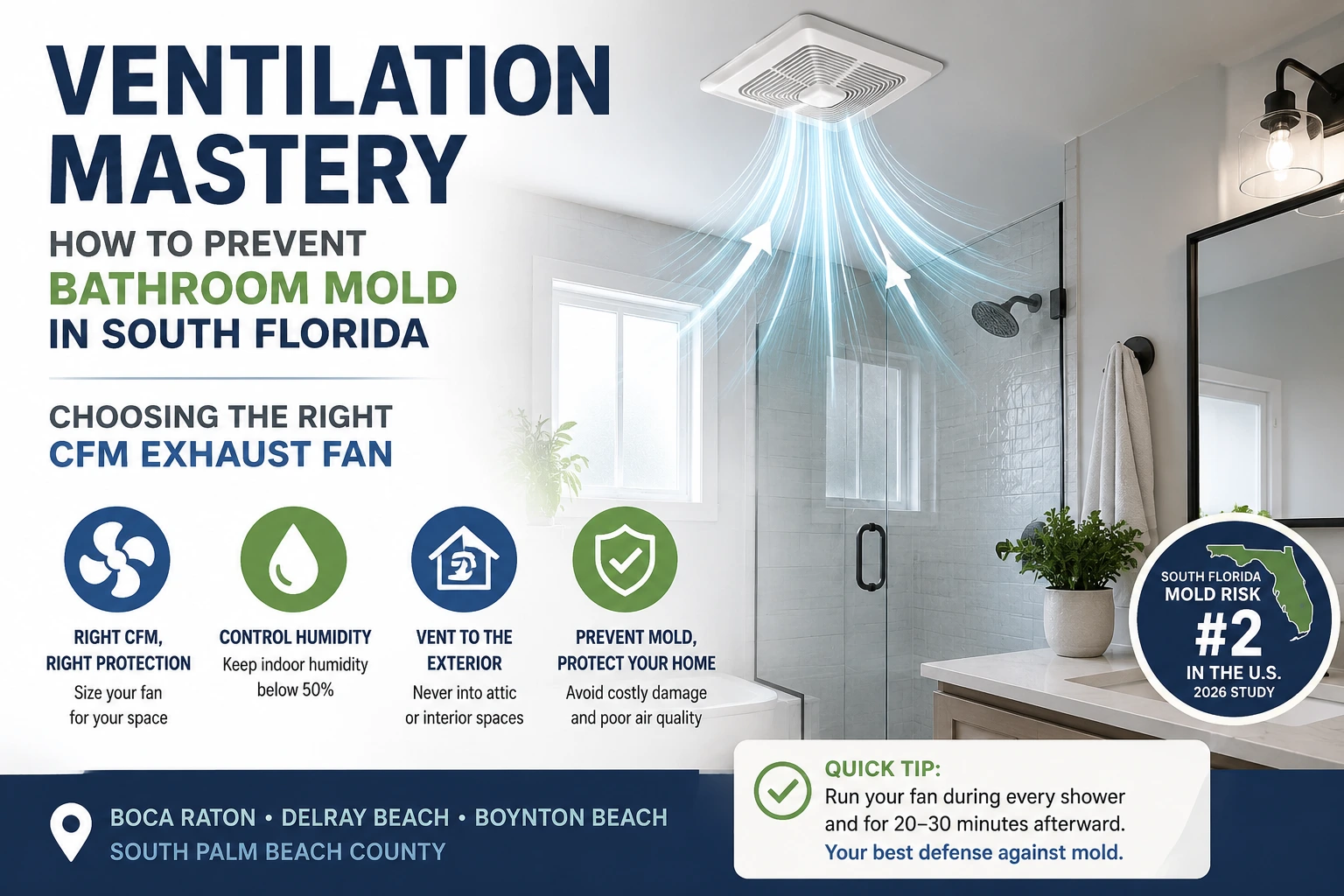
What is the right CFM exhaust fan for a South Florida bathroom? Use 1 CFM per square foot of bathroom floor space as your baseline. In South Florida’s subtropical climate — where indoor humidity regularly exceeds 70% — size up by 25% to account for the extra moisture load. A 100 sq ft master bath needs at least 110–130 CFM, not the code-minimum 50 CFM.
How do you prevent bathroom mold in South Florida? Run your exhaust fan during every shower and for 20–30 minutes afterward. Keep indoor humidity below 50% (the Florida Department of Health recommends below 60% as a hard ceiling). Vent all exhaust directly to the exterior — never into an attic or crawl space.
Bathroom Ventilation: Workflow & Risk
Proper Ducting Sequence
Establish an Exterior Path
Map a direct route to the outside envelope. The Florida Building Code prohibits terminating ductwork inside an attic, crawlspace, or soffit overhang.
Install Rigid Smooth-Wall Ducting
Select rigid aluminum or galvanized piping. Corrugated flexible ducting creates severe turbulence that can slash real-world CFM delivery by up to 50%.
Insulate the Attic Run
Wrap all ducts running through unconditioned spaces. This prevents hot attic air from causing humid exhaust steam to condense and pool back into your ceiling.
Anchor Damper & External Cap
Fit a spring-loaded backdraft damper to block outdoor humidity. Terminate using a hurricane-rated cap with AMCA Standard 550 wind-driven rain resistance.
💰 Financial Risk vs. Prevention
| Baseline Prevention Setup | $150 – $300 |
| Minor Surface Remediation | $500 – $2,000 |
| Structural Remediation & Re-Drywalling | $2,000 – $5,000 |
| Complex Sub-Tile & Framing Mitigation | $6,000 – $15,000+ |
*Based on local Palm Beach County remediation averages. Sizing up your ventilation infrastructure early removes human error and prevents hidden wall cavity colonization.
Key facts at a glance:
- Florida Building Code (2023, 8th Edition) requires a minimum of 50 CFM for bathroom exhaust
- South Florida humidity averages above 70% for most of the year — nearly double what triggers mold growth
- Mold can colonize a damp bathroom surface in as little as 24–48 hours
- Bathroom mold remediation in Palm Beach County costs $500–$10,000+ depending on spread
- A properly sized exhaust fan running on a timer costs roughly $150–$300 installed — a fraction of remediation costs
Who This Post Is For
This guide is useful if you are:
- ✅ A homeowner in Boca Raton, Delray Beach, Boynton Beach, or anywhere in South Palm Beach County
- ✅ A condo owner dealing with persistent tile mold or musty bathroom odors
- ✅ Someone who just moved to South Florida from a drier climate and is surprised by how fast mold shows up
- ✅ A landlord or property manager wanting to reduce mold complaints and liability
- ✅ A contractor or remodeler looking for local code compliance answers
Bathroom Fan Size Calculator (South Florida)
Enter your bathroom size to calculate the recommended exhaust fan CFM.
Formula used: Bathroom Area × 1.25 (recommended for South Florida humidity conditions).
Note: HVI guidelines generally recommend a minimum of 50 CFM for bathrooms up to 50 sq ft.
Why South Florida Bathrooms Are a Mold Magnet
South Florida is not like anywhere else in the country when it comes to moisture. According to a 2026 study cited by AirMD, Florida ranks second only to Louisiana as the state where homes are most likely to develop mold problems. That is not a coincidence — it is a direct result of the climate.
Palm Beach County sees average outdoor humidity above 70% for most of the year. Annual rainfall approaches 60 inches. The rainy season runs from June through November, which means six solid months of the air being saturated before a single drop of shower steam hits your tiles.
Here is the part most people miss: your bathroom adds its own moisture layer on top of an already saturated outdoor environment.
What this means for your bathroom:
- Shower steam can push indoor humidity to 80–100% within minutes
- Without active ventilation, that moisture lingers long enough for mold spores to anchor and grow
- Mold only needs warmth, spores (which are always present in Florida air), and moisture above 60% relative humidity
- The Florida Department of Health confirms that without controlled humidity, mold can establish in as little as 24 hours after water exposure
The fix is not complicated. But it requires the right equipment, correctly sized, correctly installed. Let’s break it down.
Local Mold Statistics: What the Data Shows for Boca Raton and South Palm Beach County
Most mold articles give you national averages. This section is specific to where you live.
According to Palm Beach County climate data tracked through the National Centers for Environmental Information (NCEI), South Palm Beach County records average annual rainfall of 60+ inches, an average temperature of 72.7°F year-round, and sustained outdoor relative humidity above 72% across most months. Those three conditions combine to create one of the highest residential mold risk environments in the United States.
The peak window is June through September. During those four months, daily outdoor humidity in Boca Raton, Delray Beach, and Boynton Beach routinely hits 85–95% by late morning — before afternoon storms push it even higher. Any bathroom that is not actively ventilated during this window is accumulating moisture damage with every single shower.
What we see in South Palm Beach County bathrooms during June–September:
- Grout lines in shower tiles begin showing gray or black discoloration within 4–6 weeks of poor ventilation habits
- Caulk around tub surrounds develops mold beneath the surface even when the surface appears clean
- Bathroom ceiling drywall, particularly in condos where the floor above creates a sealed cavity, absorbs moisture and begins to soften before visible mold appears
- Palm Beach County mold remediation companies report 30–50% higher call volumes during the June–September rainy season compared to the winter dry season
Typical issues we see in Boca Raton condos specifically: Condo bathrooms in Boca Raton present a distinct set of challenges compared to single-family homes. Concrete construction limits natural airflow between units. Exterior venting paths are often longer and more convoluted, which reduces actual CFM delivery at the fan. Many Boca Raton condo associations restrict exterior modifications, which can complicate proper vent cap installation. And because condos share HVAC systems or have tighter envelope construction, humidity from one bathroom can affect adjacent units through shared wall cavities.
The Environmental Protection Agency (EPA) classifies indoor mold as an issue requiring action regardless of species or size. In a condo setting, that is particularly important — mold behind one unit’s shower wall can become a neighbor’s air quality problem.
Key local stats at a glance (2026 data):
| Metric | South Florida / Palm Beach County |
| Average outdoor humidity | Above 72% most of the year |
| Rainy season duration | June–November (6 months) |
| Annual rainfall | ~60 inches |
| Mold risk ranking (national) | #2 in the U.S. (behind Louisiana) |
| Mold remediation — bathroom (Palm Beach County) | $3,000–$10,000+ |
| Time for mold to establish on damp surfaces | 24–48 hours |
| Peak mold complaint months (local) | June, July, August, September |
Sources: AirMD South Florida Mold Report 2026,Boca Raton Tribune March 2026,Florida Department of Health
What Does CFM Actually Mean — and Why Does It Matter?
CFM stands for cubic feet per minute. It measures how much air volume your exhaust fan moves in 60 seconds. The higher the CFM, the faster the fan clears humid air from the room.
Think of it like this: a low-CFM fan is like draining a bathtub through a coffee stirrer. It technically works, but it is so slow that the water (humidity) keeps doing damage while you wait.
The standard CFM calculation:
- Base rule: 1 CFM per square foot of bathroom floor space
- South Florida adjustment: multiply by 1.25 due to baseline outdoor humidity
- Example: A 100 sq ft bathroom normally needs 100 CFM, but in Boca Raton, target 125 CFM
CFM sizing table by bathroom size (South Florida recommended):
| Bathroom Size | Standard CFM | South Florida CFM |
| Under 50 sq ft | 50 CFM (minimum) | 65+ CFM |
| 50–75 sq ft | 60–75 CFM | 80–95 CFM |
| 75–100 sq ft | 80–100 CFM | 100–125 CFM |
| 100–150 sq ft (master) | 110–150 CFM | 140–190 CFM |
| Over 150 sq ft | 150+ CFM | 190+ CFM |
Add 50 CFM per toilet in a separate enclosure. Add 50–100 CFM if you have a jetted tub or steam shower. Never round down in South Florida — always round up.
What Does Florida Building Code Actually Require for Bathroom Ventilation?
Here is the legal baseline you need to know before buying anything.
The 2023 Florida Building Code, Residential (8th Edition) requires:
- All bathroom exhaust fans must vent directly to the exterior of the building
- Exhaust cannot discharge into an attic, crawl space, soffit, or any interior area
- Minimum intermittent airflow: 50 CFM for bathrooms
- Exhaust fans must be controlled by an independent switch (timer switches are specifically encouraged)
The code sets a floor, not a ceiling. And that floor was designed for climates that are far less humid than South Florida. A 50 CFM fan in Boca Raton is technically compliant. It is also almost certainly not enough to prevent mold in a typical bathroom.
The attic venting mistake costs homeowners thousands: Many older homes in South Palm Beach County still have fans that dump exhaust into the attic space. This is no longer code-compliant under the current FBC, and it is one of the most destructive moisture mistakes you can make. Attic humidity from bathroom exhaust causes mold to colonize roof decking and framing — damage that can run $10,000–$25,000 to repair. If your home was built before 2000, verify where your exhaust vents.
How to Choose the Right Exhaust Fan for a South Florida Bathroom
Choosing a fan is not just about CFM. Four factors matter equally: noise level, motor type, humidity sensing, and duct compatibility.
What sone rating should I look for in a bathroom fan?
Sones measure how loud a fan sounds. The lower the number, the quieter the fan. This matters more than most people think because a loud fan gets turned off. A turned-off fan does nothing.
- Below 1.0 sone: quiet enough that you barely notice it running
- 1.0–2.0 sones: acceptable for guest baths
- Above 2.0 sones: noticeably loud; people avoid using it
In South Florida, where fans need to run 20–30 minutes after every shower, quiet matters. A fan that sounds like a small jet engine trains everyone in the house to shut it off as soon as they step out.
Recommended quiet models for 2026:
- Panasonic WhisperCeiling DC (FV-0511VKS2): 110 CFM, 0.3 sones, ENERGY STAR certified, ~$200. This is the benchmark for quiet performance and the most recommended model for South Florida master baths.
- Panasonic WhisperSense DC: 110 CFM, 0.3 sones, includes humidity and motion sensors, ~$250. Best choice if you want hands-free operation.
- Broan-NuTone Roomside (BFST110): 110 CFM, 0.7 sones, ~$120. Installs without attic access — excellent for retrofits in Boca Raton condos where ceiling access is limited.
- Delta BreezSlim (GBR80H): 80 CFM, 1.0 sone, humidity sensor, only 5.5 inches deep — best for shallow ceiling cavities in older construction.
- Broan Evolve (PTE511RK): 110 CFM, 0.6 sones, ENERGY STAR, ~$212. Strong choice for new construction and full remodels.
Should I get a humidity-sensing bathroom exhaust fan?
Yes. Especially in South Florida.
A humidity-sensing fan monitors the relative humidity in the room and turns on automatically when it exceeds a set threshold — usually 60–70% RH. It turns off when the air returns to normal. You cannot forget to run it. You cannot leave it off by accident.
This is particularly valuable in households with children, rental properties, and guest bathrooms where ventilation habits vary.
The Panasonic WhisperSense and Delta BreezGreenBuilder with humidity sensor are both strong options under $250. The sensor pays for itself quickly in avoided remediation costs.
DC motor vs. AC motor — does it matter for Florida homes?
It matters. DC motors are more energy-efficient and, critically, quieter. They also maintain consistent airflow performance better than AC motors as ductwork resistance increases over time. In South Florida, where fans run more hours per day than in other regions, the energy savings on a DC motor fan add up.
The Panasonic WhisperCeiling DC line is the gold standard here. The DC motor maintains rated CFM even with longer or bent duct runs — which is common in Florida homes where exterior venting requires navigating through walls or soffits.
How Should I Duct a Bathroom Exhaust Fan in South Florida?
This is where most DIY installations go wrong — and where mold problems actually start.
Proper ductwork is as important as the fan itself. A high-performance fan connected to bad ductwork delivers poor results.
The rules for South Florida installations:
- Always vent to the exterior. The 2023 FBC is unambiguous: exhaust cannot go into the attic. If it does, you will grow mold in your attic. Period.
- Use smooth-wall rigid duct, not flexible corrugated duct. Flexible duct can cut effective CFM by 30–50% due to interior ridges that create turbulence. A 100 CFM fan on bad flex duct can deliver as little as 50–60 CFM at the outlet.
- Keep duct runs short and straight. Every 90-degree elbow costs you roughly 5–10% of effective airflow. Plan the duct path to minimize bends.
- Insulate the duct where it runs through unconditioned space. In South Florida, this matters mainly in attic runs. An uninsulated duct in a hot attic (which can reach 150°F+ in summer) causes condensation inside the duct — and that condensation drips back into your ceiling.
- Install a backdraft damper. This prevents warm, humid outdoor air from creeping back into your bathroom when the fan is off. Most quality fans include one; verify before purchasing.
- Use a proper exterior vent cap. In Florida’s hurricane-prone region, the 2023 Florida Building Code Mechanical, Chapter 5 specifies that louvers on exterior openings must comply with AMCA Standard 550 for wind and rain resistance. Use a quality louvered or gooseneck cap, not a cheap plastic flap.
How Long Should You Run a Bathroom Exhaust Fan in Florida?
This question comes up constantly, and the answer surprises people.
Most homeowners run their fan during the shower, then turn it off when they step out. That is not enough — especially in South Florida.
The correct usage pattern:
- Turn the fan on before you start the shower
- Keep it running during the entire shower
- Leave it running for 20–30 minutes after you finish
Running a properly sized fan for 20–30 minutes post-shower drops bathroom humidity by roughly 40%, according to data from the Home Ventilating Institute. In South Florida’s climate, that 40% drop is the difference between mold-free tile grout and a gray fuzz problem three months later.
The easiest solution: install a timer switch.
A $20–$40 timer switch lets you set a fixed run time — 20, 30, or 60 minutes — then the fan shuts off automatically. No one has to remember. The Florida Building Code explicitly encourages timer-controlled bathroom fans for this reason.
Lutron, Leviton, and Intermatic all make reliable timer switches compatible with standard fan wiring. This is one of the highest-ROI upgrades you can make for under $50.
What Happens If You Ignore Bathroom Ventilation in South Florida?
Let’s be direct about the financial stakes.
A homeowner in West Boca told me she ignored a musty smell in her master bath for eight months. She assumed it was just “Florida humidity.” When a plumber finally opened the wall to fix a slow drain, the drywall behind the shower surround was black. The remediation bill: $4,200.
That is not unusual. Here is what the data shows for South Florida in 2026:
Mold remediation costs in Palm Beach County (2026 data):
- Surface bathroom mold (under 10 sq ft): $500–$2,000
- Mid-range bathroom spread (10–50 sq ft, including drywall removal): $2,000–$5,000
- Complex cases (behind tiles, into framing, HVAC involvement): $6,000–$15,000+
- Whole-home post-flood remediation: $20,000–$30,000+
Source: MoldOnly Florida 2026 Remediation Cost Guide
Beyond remediation, mold affects property values. Studies show visible mold can reduce a home’s resale value by 20–37%. In Boca Raton’s real estate market, where median home prices remain elevated, that is a significant exposure.
A $200 exhaust fan and a $40 timer switch can prevent all of that.
Does My A/C Help Prevent Bathroom Mold in South Florida?
Yes — but not enough on its own.
Your air conditioner does dehumidify the air as a secondary function. But here is the problem: it is not designed for the localized, rapid humidity spikes a shower creates. In the 10–15 minutes of a hot shower, bathroom humidity can hit 90–100%. Your central AC has no chance of responding fast enough.
Your exhaust fan handles the acute, localized moisture spike. Your AC handles the ongoing background humidity management. They work together.
If your indoor humidity stays above 60% even with the AC running properly, the Florida Department of Health recommends having your AC system inspected for problems. A unit that is undersized, has a dirty coil, or has low refrigerant will fail to dehumidify adequately.
Tools that help alongside your exhaust fan:
- Digital hygrometer ($15–$25): displays real-time indoor humidity; place one in your bathroom to verify conditions
- Smart humidity controller: pairs with your exhaust fan to automate based on RH readings
- Whole-house dehumidifier ($1,300–$2,800 installed): high-ROI upgrade for Boca Raton homes with persistent humidity issues throughout the house
Common Bathroom Ventilation Mistakes South Florida Homeowners Make
After reviewing how dozens of local homes handle ventilation, the same errors show up repeatedly.
Mistake 1: Keeping the builder-grade 50 CFM fan. New construction in South Florida often comes with the code-minimum 50 CFM fan. Builders install the smallest legal option to keep costs down. For the tri-county region’s humidity levels, a 50 CFM fan in anything larger than a small half-bath is inadequate. Upgrade it.
Mistake 2: Venting into the attic. Still common in homes built before 2000 in Boca Raton, Delray Beach, and Boynton Beach. Non-compliant with current code and causes severe attic mold. Check your duct termination point before hurricane season. The Environmental Protection Agency (EPA) specifically identifies poor ventilation as the leading preventable cause of indoor mold growth — and attic venting is the worst version of that mistake.
Mistake 3: Using flexible duct for long runs. Flexible duct is acceptable for short connections (under 4 feet). For anything longer, use smooth rigid metal duct. Your fan’s real-world CFM output depends on it.
Mistake 4: Not running the fan long enough. Turning the fan off when you step out of the shower is like turning off your car’s windshield wipers when it is still raining. The moisture is still there.
Mistake 5: Skipping the timer switch. Manual switches require everyone in the household to remember the 20–30 minute rule. They will not. Install a timer switch and remove the human variable.
Mistake 6: Neglecting fan maintenance. A bathroom fan grille clogged with dust and lint can lose 30–40% of its rated CFM. Clean the grille and housing every 3–4 months. In South Florida, dust accumulates faster due to A/C cycling.
Builder-Grade Fan vs. Properly Sized Fan: What’s the Real Difference?
This is the comparison no one shows you when you move into a new build in Boca Raton, Delray Beach, or Boynton Beach.
Your builder installed a fan. It passes code. It moves air. And it is almost certainly not doing the job your bathroom actually needs — especially here in South Florida.
Here is why that matters, broken down side by side:
| Feature | Builder-Grade Fan (typical) | Properly Sized Fan (recommended) |
| CFM rating | 50 CFM | 110–150 CFM (master bath) |
| Sone rating | 2.5–4.0 sones (loud) | 0.3–1.0 sones (near silent) |
| Motor type | AC motor | DC motor |
| Humidity sensor | No | Yes (on recommended models) |
| Timer switch | No | Yes ($30–$40 add-on) |
| Duct compatibility | Flex duct, often into attic | Rigid duct, exterior-vented |
| Post-shower humidity drop | Minimal — 10–15% in 30 min | ~40% in 20–30 minutes |
| Expected lifespan | 5–8 years | 15–20+ years (Panasonic warranty) |
| Annual energy cost | ~$15–$20 | ~$8–$12 (DC motor efficiency) |
| Mold prevention effectiveness | Low in South Florida climate | High, purpose-built for humid zones |
| Approximate fan cost | $30–$60 | $120–$250 |
The real cost of the builder-grade fan is not the purchase price — it is the mold remediation bill you pay 3–5 years later.
A 50 CFM fan in a 100 sq ft master bath in Boca Raton performs roughly 3 air changes per hour. The Home Ventilating Institute recommends 8 air changes per hour for adequate moisture control. That builder fan is running at less than 40% of what your bathroom actually needs.
In a drier climate, that gap is manageable. In South Florida — where the outdoor air arriving to replace the exhausted air is already at 70%+ relative humidity — it is not. You are fighting a moisture battle with inadequate equipment.
Here is the bottom line: upgrading from a builder-grade 50 CFM fan to a properly sized 110 CFM DC motor fan with a timer switch costs roughly $150–$250 in parts plus installation. The average bathroom mold remediation job in Palm Beach County costs $3,000–$10,000. The math is straightforward.
The Environmental Protection Agency (EPA) recommends keeping indoor relative humidity between 30–60% to prevent mold. A builder-grade fan cannot reliably achieve that in a South Florida bathroom. A properly sized fan, correctly installed, consistently can.
How to Test Whether Your Bathroom Exhaust Fan Is Actually Working
You can diagnose a weak or failing fan in 60 seconds.
The tissue paper test: Hold a single-ply tissue near the fan grille while it is running. If the fan has adequate suction, the tissue will be pulled firmly against the grille and held there. If it flutters or falls, your fan is underperforming — likely due to a dirty grille, duct blockage, or an undersized motor.
What to check if the tissue test fails:
- Remove and clean the grille (a common fix that restores 20–30% of lost performance)
- Check for duct disconnections in the attic (a common issue after Florida storms)
- Verify the exterior vent cap is not blocked by debris, nesting birds, or a closed damper
- Measure the actual run time after showers — many fans run less than 10 minutes when they should run 30
If your fan is more than 10 years old and fails the tissue test, replacement is usually the better economic choice over repair.
Frequently Asked Questions: Bathroom Ventilation and Mold in South Florida
1. What is the minimum CFM required by Florida law for a bathroom exhaust fan? The 2023 Florida Building Code requires a minimum of 50 CFM for intermittent bathroom ventilation. However, this is the legal minimum, not the recommended amount. For South Florida’s climate, most bathrooms need significantly more.
2. Can I vent my bathroom exhaust fan into the attic in Florida? No. Florida Building Code (2023 FBC Residential, Chapter 15) prohibits venting bathroom exhaust into attics, crawl spaces, soffits, or any interior area. All exhaust must discharge directly to the outdoors. Violations are a common cause of severe attic mold in Palm Beach County homes.
3. How long should I run my bathroom exhaust fan after showering in South Florida? Run it for at least 20–30 minutes after every shower. South Florida’s outdoor humidity makes the post-shower window more critical than in other climates. A $30 timer switch automates this without relying on memory.
4. What size exhaust fan do I need for a South Florida master bathroom? For a typical 100–120 sq ft master bath in Boca Raton or surrounding areas, choose a fan rated at 110–150 CFM. Add 50 CFM for a separate toilet compartment and 50–100 CFM for a steam shower or jetted tub.
5. Does a humidity-sensing exhaust fan work better than a manual switch in Florida? Yes, particularly for South Florida homes. A humidity-sensing fan turns on automatically when humidity rises and shuts off when it drops to safe levels. This removes human error from the equation and ensures the fan runs whenever it is actually needed.
6. Will my air conditioner prevent bathroom mold without an exhaust fan? No. Your AC dehumidifies gradually across the whole home but cannot respond fast enough to the rapid humidity spikes during a shower. An exhaust fan handles the acute, localized moisture spike that the AC cannot address in real time.
7. How much does bathroom mold remediation cost in Boca Raton in 2026? For surface bathroom mold under 10 sq ft, expect $500–$2,000. Larger or hidden growth behind tiles or drywall runs $2,000–$10,000+ in South Florida, where labor costs and storm-related claim volumes are higher than state averages.
8. What is the quietest bathroom exhaust fan for a South Florida home? The Panasonic WhisperCeiling DC (FV-0511VKS2) at 0.3 sones is the quietest high-performance option available in 2026. At 110 CFM and 0.3 sones, it is effectively silent during normal activity. Its DC motor also maintains consistent CFM output in long duct runs.
9. Can bathroom mold affect indoor air quality across the whole house in Florida? Yes. Mold spores become airborne and can spread through HVAC systems to other rooms. In South Florida’s open floor plans and centrally air-conditioned homes, a mold problem in one bathroom can affect air quality throughout the residence. This is why the EPA recommends addressing all indoor mold regardless of size.
10. Is there a tax credit or rebate for installing an ENERGY STAR bathroom fan in Florida? ENERGY STAR certified bathroom fans may qualify for federal tax credits under the Inflation Reduction Act provisions still active in 2026. Florida does not offer a separate state rebate program for exhaust fans, but some Florida Power & Light (FPL) and utility efficiency programs may include ventilation improvements. Check with your utility provider for current offers.
11. How do I know if my bathroom exhaust fan duct is connected properly? Do the tissue paper test at the fan grille. Then go outside and check the exterior vent cap — you should see the louvered flap open and feel air coming out while the fan runs. If there is no airflow at the exterior vent, the duct may be disconnected, kinked, or blocked.
12. What are the best bathroom ventilation habits for South Florida renters who cannot install a new fan? If the existing fan is weak, maximize it by keeping showers shorter and cooler, using a portable dehumidifier, leaving the bathroom door open after showering, and running the existing fan for as long as possible. Report persistent mold issues to your landlord — Florida landlords are legally required to maintain habitable conditions, which includes functioning ventilation in bathrooms.
Conclusion: The Right Fan Is the Cheapest Insurance You Can Buy in South Florida
South Florida’s bathroom mold problem is not mysterious. It is predictable, measurable, and entirely preventable with the right exhaust fan, properly sized, correctly installed, and actually used.
A 2026 study ranked Florida second in the country for mold risk. Palm Beach County humidity exceeds 70% most of the year. The Florida Department of Health advises keeping indoor humidity below 50% as the most effective mold prevention measure. Mold can establish in 24–48 hours. And remediation in Boca Raton, Delray Beach, and Boynton Beach runs $3,000–$10,000 for even moderate bathroom cases.
Compare that to a $200 Panasonic WhisperCeiling DC fan, a $40 timer switch, and a $30 digital hygrometer. Under $300, properly installed, actively prevents the most common and expensive home maintenance problem in this region.
Here is my genuine advice: if your bathroom fan is more than 10 years old, builder-grade, rated under 80 CFM, or louder than a conversation, replace it this season. Do not wait for the musty smell to confirm what physics already guarantees.
What ventilation issue are you dealing with in your South Florida home? Drop your question below — I am happy to help you size the right solution for your specific space.
2026 Ventilation Watch: Technologies Worth Monitoring
South Florida homeowners should be aware of several emerging technologies that may change bathroom ventilation strategy over the next 2–3 years.
Smart Ventilation Controllers: Wi-Fi connected exhaust fans now integrate with home automation platforms (Google Home, Amazon Alexa, Apple HomeKit). Models like the Broan SmartSense allow humidity data logging so you can track moisture trends over weeks — particularly useful for condo owners and landlords managing multiple units remotely.
Heat Recovery Ventilators (HRV) for South Florida: HRVs are more common in cold-climate applications, but manufacturers including Broan are releasing humidity-optimized variants that pre-condition incoming air. In South Florida’s “cooling load” climate, Energy Recovery Ventilators (ERVs) are the more appropriate version — they transfer both heat and moisture, reducing the demand on your AC while improving fresh air exchange rates.
Mold-Resistant Duct Coatings: New antimicrobial duct liner materials entering the residential market in 2026 reduce mold colonization inside ductwork itself — a real concern in South Florida where attic-routed ducts operate in warm, humid conditions even with proper exterior venting.
AI-Powered Indoor Air Quality Monitors: Devices like the Awair Element and Airthings Wave Plus now track humidity, CO₂, VOCs, and particulate matter simultaneously. Paired with a smart exhaust fan, these create a closed-loop system that responds to actual air quality data rather than running on fixed timers.
Data sources and references used in this article:
- Florida Department of Health — Mold Resources
- 2023 Florida Building Code, Residential, 8th Edition — Chapter 15 Exhaust Systems
- My Florida Home Energy — Ventilation
- Home Ventilating Institute — Bathroom Exhaust Fans
- EPA Mold Resources
- AirMD — South Florida Mold Testing 2026
- MoldOnly — Florida Remediation Costs 2026
- Boca Raton Tribune — Florida Mold Risk 2026