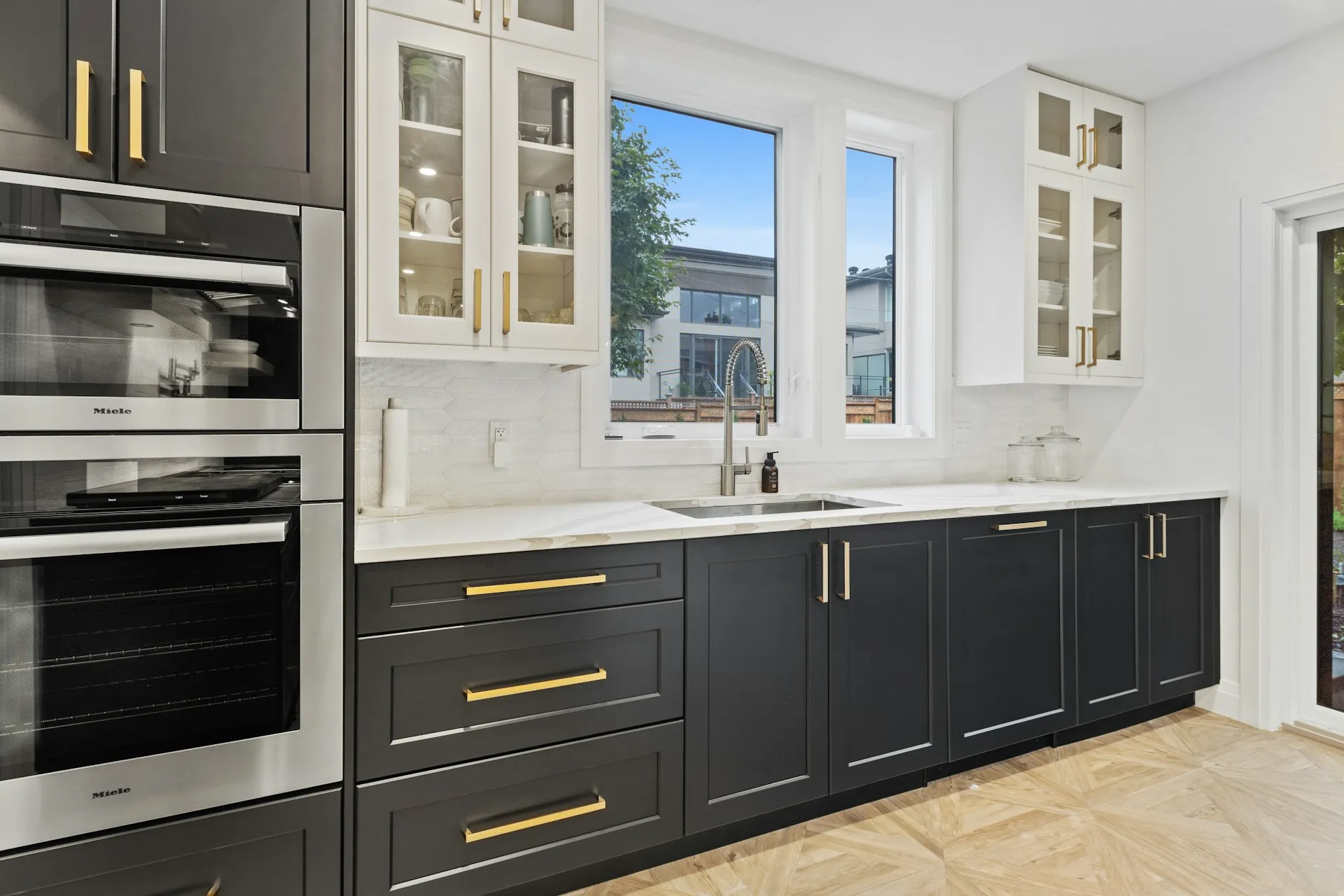
Custom vs Semi-Custom vs Stock is one of the most important choices in a kitchen remodel. Cabinets shape storage, layout, budget, resale value, and daily comfort. A smart cabinet choice can save thousands and prevent years of frustration.
The best choice depends on your kitchen size, timeline, home value, and lifestyle. Stock cabinets work for fast budget projects, semi-custom cabinets fit most homeowner remodels, and custom cabinets make sense for complex layouts or high-value homes.
Quick guide
Stock cabinets are best for fast, budget-friendly kitchen updates. Semi-custom cabinets are best for most homeowners because they balance price, fit, style, and storage. Custom cabinets are best when the kitchen has unusual dimensions, luxury finishes, long-term ownership plans, or special storage needs. In 2026, homeowners should also compare wood tone trends, aging-in-place storage, formaldehyde compliance, local labor rates, and installation quality before choosing.
This guide is helpful for these readers
Use this guide if you are in one of these situations.
| Reader type | Why this guide helps |
| Homeowners planning a kitchen remodel | You can compare cabinet types before calling a contractor. |
| Local homeowners researching cabinet ideas near them | You can understand how local labor and supplier access affect price. |
| First-time remodelers | You can avoid expensive cabinet buying mistakes. |
| Rental property owners | You can choose durable cabinets without overspending. |
| Luxury home renovators | You can decide when custom cabinetry is worth it. |
| DIY remodelers | You can see where stock or RTA cabinets may work. |
| Contractors and remodelers | You can use this as a client education resource. |
| Aging-in-place planners | You can choose pullouts, lighting, drawers, and accessible storage. |
Why Kitchen Cabinet Ideas: Custom vs Semi-Custom vs Stock matters more in 2026
Cabinets are not just boxes on walls anymore. They now hide appliances, support beverage stations, organize recycling, handle heavy cookware, and shape open living spaces.
Here is what changed. The 2026 Houzz Kitchen Trends Study found that functionality is becoming a bigger renovation driver. Kitchen deterioration or dysfunction rose to 38%, while dissatisfaction with style reached 41%. The same study reported median spending of $55,000 for major kitchen remodels and $20,000 for minor kitchen remodels. Larger major kitchen remodels reached a median of $75,000. (Houzz)
That means a cabinet mistake is not small. A poor layout can affect a large share of the remodel budget. A weak cabinet box can also make a beautiful countertop feel like lipstick on a tired wall.
The National Kitchen and Bath Association also reports that 2026 kitchens are moving toward lifestyle upgrades. Designers expect more beverage areas, pet feeding stations, eat-in kitchens, pantry storage, and smarter drawers. NKBA also reports growing interest in under-cabinet lighting, interior cabinet lights, and embedded technology. (nkba.org)
Here is my strong opinion. Most homeowners should start with semi-custom cabinets, not custom or stock. Semi-custom gives enough flexibility for real kitchens without paying for endless decisions.
Custom is wonderful when it solves a real problem. Stock is useful when speed and budget matter most. Semi-custom is where many normal families find the best value.
Guides for kitchen remodeling and renovation.
- Kitchen remodeling services
- Kitchen remodel cost guide
- Open Concept Kitchen Remodeling
- The Best Kitchen Remodeling Materials
What is the real difference between stock, semi-custom, and custom cabinets?
Stock cabinets are pre-made in fixed sizes. Semi-custom cabinets use standard systems with more options. Custom cabinets are built from scratch for your exact space.
This sounds simple, but the difference becomes real during installation.
Stock cabinets usually come in standard widths, often in 3-inch increments. The installer uses fillers to close awkward gaps. Fillers are not always bad, but too many fillers make a kitchen feel patched together.
Semi-custom cabinets allow more changes. You may get more door styles, finish choices, depth adjustments, storage accessories, and cabinet sizing options. Some lines allow 1-inch size changes.
Custom cabinets are different. A cabinet maker can build around a sloped ceiling, odd wall, historic trim, oversized fridge, or exact drawer plan. The kitchen becomes a fitted system instead of a product order.
I once saw a homeowner choose stock cabinets for a 1920s home with uneven plaster walls. The cabinet price looked great at first. The final kitchen used wide fillers beside the range, a strange dead corner, and a tiny drawer where a spice pullout should have been.
That project taught me something. Cheap cabinets can become expensive when the layout fights the room.
Which cabinet type is best for most local kitchen remodels?
Semi-custom cabinets are best for most local kitchen remodels because they balance cost, fit, lead time, storage, and design choice.
Most kitchens are not perfect rectangles. Most families also do not need museum-grade millwork.
Semi-custom cabinets work well when you want a better layout, stronger storage, and more finish control. They also help when your local contractor needs a predictable product timeline.
Stock cabinets make sense for rentals, flips, laundry rooms, basement kitchens, and quick replacements. Custom cabinets make sense for forever homes, luxury remodels, historic homes, and complex floor plans.
A local contractor usually thinks about three things before recommending a cabinet tier.
| Decision factor | Stock | Semi-custom | Custom |
| Budget control | Strong | Good | Weak |
| Speed | Strong | Medium | Weak |
| Layout flexibility | Weak | Good | Excellent |
| Finish options | Limited | Good | Excellent |
| Storage planning | Basic | Strong | Excellent |
| Resale impression | Medium | Strong | Very strong |
| Best use case | Simple remodel | Main family kitchen | High-end or complex kitchen |
The best cabinet type is not the fanciest one. The best one solves your real kitchen problem.
How much do kitchen cabinets cost in 2026?
In 2026, installed cabinet costs vary widely. Stock and semi-custom cabinets often range from about $350 to $800 per linear foot, while custom cabinets can reach $500 to $1,200 or more per linear foot.
HomeLight reports that stock or semi-custom cabinet installation averages about $100 to $650 per linear foot. It also estimates $2,000 to $13,000 for a 10-by-10 kitchen using stock or semi-custom styles. Custom cabinets can cost $500 to $1,200 per linear foot, or about $10,000 to $24,000 for a 10-by-10 kitchen. (HomeLight)
Angi’s 2026 custom cabinet guide lists a normal full-kitchen custom cabinet range of $2,796 to $12,934. It also notes that complex materials, door styles, finishes, labor, removal, prep, and cleanup affect the total. (Angi)
Use these numbers as planning ranges, not final quotes.
| Cabinet type | Typical 2026 installed range | Best for |
| Stock | Lower budget range | Fast updates and simple layouts |
| RTA stock | Lowest product cost, more labor | Skilled DIY or budget remodels |
| Semi-custom | Mid-range | Most homeowner kitchens |
| Custom | Highest range | Complex spaces and premium homes |
Here is the cost trap nobody likes discussing. Cabinet price is not the same as cabinet project cost.
You also need to budget for removal, disposal, trim, crown molding, side panels, fillers, toe kicks, hardware, delivery, design fees, and possible electrical changes. A beverage station, panel-ready fridge, appliance garage, and built-in pantry can also move the number fast.
Are stock cabinets a smart idea or a cheap mistake?
Stock cabinets are smart when the layout is simple, the budget is tight, and the homeowner accepts limited sizes and finishes. They become a mistake when the kitchen needs precision.
Stock cabinets are not automatically low quality. Some modern stock cabinet lines use plywood boxes, soft-close hinges, and clean finishes. IKEA SEKTION, Hampton Bay, Diamond NOW, and ready-to-assemble brands can work well in the right project.
The problem is not always the cabinet. The problem is the mismatch.
Stock cabinets work best when:
| Situation | Why stock works |
| Rental property | Fast replacement and controlled cost |
| Small condo kitchen | Standard sizes often fit well |
| Laundry or utility area | Function matters more than custom detail |
| Tight timeline | Product availability is a major advantage |
| DIY-friendly remodel | RTA or modular stock can reduce cost |
Stock cabinets struggle when you want ceiling-height storage, integrated panels, unusual depths, or highly specific finishes.
I like stock cabinets for honest projects. A small rental kitchen does not need walnut inset cabinetry. It needs durable boxes, clean doors, functional drawers, and hardware that survives daily use.
The mistake is pretending stock will behave like custom.
When are semi-custom cabinets worth the extra cost?
Semi-custom cabinets are worth it when better sizing, stronger storage, upgraded finishes, and cleaner installation will improve daily use.
Semi-custom cabinets usually cost more than stock, but they often reduce awkward compromises. That matters because kitchen frustration repeats every day.
Think about the small daily irritations. A pan drawer that catches. A trash pullout in the wrong place. A pantry that wastes the top shelf. A cabinet door that hits the dishwasher handle.
Semi-custom can solve many of those issues without full custom pricing.
Good semi-custom upgrades include:
| Upgrade | Why it matters |
| Deeper fridge panels | Creates a more built-in look |
| Pullout trash and recycling | Improves prep and cleanup flow |
| Drawer bases | Better for pots, pans, and aging-in-place |
| Tray dividers | Solves baking sheet chaos |
| Pantry pullouts | Helps small kitchens store more |
| Soft-close hardware | Reduces wear and noise |
| Finished end panels | Makes exposed sides look intentional |
The 2026 Houzz trend report shows pantry cabinets are the top built-in feature, with 47% of homeowners choosing them. Beverage stations reached 24%. Those features often work better with semi-custom or custom planning than with basic stock boxes. (Houzz)
My favorite semi-custom move is simple. Replace lower cabinet doors with drawers wherever the budget allows.
Drawers cost more. Drawers also change how a kitchen feels at 7 p.m. when someone is tired, hungry, and looking for one pan.
When do custom cabinets make financial sense?
Custom cabinets make financial sense when the home value, layout complexity, design goals, and ownership timeline justify the higher price.
Custom cabinets should not be treated as a status symbol. They should be treated as a solution.
Custom makes sense when your kitchen has:
| Kitchen issue | Why custom helps |
| Uneven walls | Cabinets can be scribed to fit |
| Historic architecture | Details can match original trim |
| Tall ceilings | Storage can reach the full height |
| Luxury appliances | Panels and clearances need precision |
| Odd corners | Dead space can become storage |
| Accessibility needs | Heights and clearances can be tailored |
| Long-term ownership | Durability and fit matter more |
Custom cabinets can also protect a high-end remodel from looking generic. A luxury countertop on average boxes can feel wrong. A custom island, inset doors, walnut interiors, or furniture-style pantry can make the room feel planned.
Here is the contrarian view. Custom cabinets are sometimes cheaper emotionally.
A homeowner who plans to stay 15 years may regret stock cabinets every morning. The cost spread across years may feel less painful than daily annoyance.
Still, custom is not always better. I have seen custom projects become stressful because every detail required a decision. Door rail width. Drawer reveal. Stain sample. Interior finish. Crown profile. Toe kick detail.
Choice fatigue is real.
What kitchen cabinet ideas are trending in 2026?
The strongest 2026 cabinet ideas include warm wood tones, slab doors, pantry storage, hidden appliances, better lighting, and aging-friendly drawer access.
Houzz reports that wood cabinets have overtaken white cabinets in renovated kitchens. Wood reached 29%, while white reached 28%. Medium wood tones led at 15%, followed by light wood at 11%. Green also edged out gray among non-neutral cabinet colors. (Houzz)
NKBA reports similar direction. Wood grain is growing in popularity, white oak leads wood types, and transitional design remains highly popular. NKBA also reports interest in slab cabinet doors, panel-faced refrigeration, panel-faced dishwashers, and solid-surface backsplashes. (nkba.org)
Good 2026 cabinet ideas include:
| Idea | Best cabinet tier |
| White oak shaker cabinets | Semi-custom or custom |
| Walnut island with painted perimeter | Semi-custom or custom |
| Slab doors with integrated pulls | Semi-custom or custom |
| Floor-to-ceiling pantry wall | Semi-custom or custom |
| Stock white shaker refresh | Stock |
| Two-tone island design | Semi-custom |
| Appliance garage | Semi-custom or custom |
| Panel-ready fridge wall | Custom |
| Pullout base cabinets | Semi-custom |
| Hidden coffee bar | Semi-custom or custom |
Here is where people get distracted. Trend reports are helpful, but your kitchen still has to work on a messy Tuesday morning.
A beautiful green cabinet is not useful if your spice storage is terrible. A white oak pantry wall is not a win if the doors block traffic.
Style should follow function, then elevate it.
How should local homeowners compare cabinet materials?
Local homeowners should compare cabinet materials by moisture resistance, box strength, finish durability, emissions compliance, and repairability.
The cabinet box matters more than many buyers think. Doors get attention, but boxes carry weight.
Common cabinet materials include:
| Material | Pros | Cons |
| Plywood | Strong, stable, moisture resistant | Costs more |
| MDF | Smooth painted finish | Can swell with moisture |
| Particleboard | Affordable and consistent | Less forgiving with water |
| Solid wood | Durable and repairable | Moves with humidity |
| Wood veneer | Warm real wood look | Needs careful edge quality |
| Thermofoil | Easy to clean | Can peel near heat |
| Laminate | Durable surface | Edge quality matters |
Indoor air quality also matters. The EPA stated in February 2026 that formaldehyde is widely used as an adhesive in wood products, including cabinets, plywood, and wood panels. EPA’s composite wood product standards exist to reduce exposure and protect public health. (US EPA)
Ask your cabinet supplier for TSCA Title VI compliance information for composite wood products. This matters most when cabinets use MDF, particleboard, plywood, or engineered panels.
Here is a practical rule. Do not pay premium prices for vague material descriptions.
A quote should not just say “wood cabinets.” It should explain box material, door material, drawer construction, finish type, hinge brand, glide brand, and warranty.
Which brands and tools should homeowners compare?
Homeowners should compare cabinet brands by fit, warranty, construction, finish consistency, design support, and local installer experience.
No brand is perfect for every kitchen. The installer matters just as much as the product.
Here are honest notes on real cabinet brands and tools.
| Brand or tool | Best use | Honest assessment |
| IKEA SEKTION | Budget stock and DIY planning | Flexible and affordable, but installation detail matters |
| Hampton Bay | Basic stock projects | Easy access, but quality varies by line |
| Diamond NOW | Quick retail cabinet updates | Convenient for standard layouts |
| KraftMaid | Semi-custom homeowner remodels | Strong option when design support is needed |
| Thomasville Cabinetry | Semi-custom retail projects | Good style range, but compare box specs |
| Fabuwood | Value-focused semi-custom kitchens | Popular with contractors for balance |
| CliqStudios | Online cabinet planning | Helpful for remote planning, but measure carefully |
| Barker Cabinets | RTA custom-size projects | Strong for skilled DIY buyers |
| Semihandmade | IKEA cabinet upgrades | Great for design lift, not a full custom system |
| Blum hardware | Hinges and drawer glides | Worth asking for by name |
| Rev-A-Shelf | Pullouts and organizers | Practical storage upgrades |
| Houzz Pro | Planning and visual research | Helpful, but do not replace local measurement |
A cabinet brand can look great online and still fail in your kitchen if the field measurements are sloppy.
This is why local contractor experience matters. A contractor who has installed the same cabinet line ten times will know the weak points.
What cabinet choice works best for resale value?
Semi-custom cabinets often offer the strongest resale balance because they look intentional without over-improving the home. Custom cabinets help in luxury markets, while stock cabinets work for entry-level homes.
Resale depends on the local market. A custom walnut kitchen may help in a premium neighborhood. The same kitchen may not pay back in a starter home.
U.S. residential construction spending remained large in early 2026. The Census Bureau reported private residential construction spending at a seasonally adjusted annual rate of $933.0 billion in January 2026. That broad housing context matters because local labor, materials, and remodeling demand still affect project pricing. (Census.gov)
For resale, buyers notice these cabinet qualities fast:
| Buyer signal | Why it matters |
| Soft-close drawers | Feels modern and cared for |
| Tall pantry storage | Solves real household needs |
| Clean inside corners | Shows quality installation |
| Durable finish | Reduces future maintenance |
| Timeless color | Avoids style regret |
| Better hardware | Creates daily confidence |
| Matching panels | Makes appliances feel integrated |
Avoid over-personalization if resale is near. A purple custom pantry with carved doors may thrill one buyer and scare ten others.
The safer path is timeless structure with personality in hardware, lighting, backsplash, and paint.
What mistakes do homeowners make when choosing cabinets?
The biggest cabinet mistakes are buying by door style only, ignoring layout, skipping hardware specs, trusting vague quotes, and underestimating installation.
Here is what nobody tells you in the showroom. The prettiest sample door is not your kitchen.
A sample door cannot show traffic flow. It cannot show how far the dishwasher opens. It cannot show whether a drawer hits an oven handle.
Common mistakes include:
| Mistake | Better move |
| Choosing color before layout | Solve storage and workflow first |
| Ignoring cabinet box specs | Ask for material and thickness |
| Assuming custom means better | Ask what problem custom solves |
| Buying stock for odd walls | Price the filler and labor impact |
| Forgetting lighting | Plan under-cabinet lights early |
| Skipping hardware details | Ask for hinge and glide brands |
| Accepting vague lead times | Get a written schedule |
| Paying too much upfront | Use clear payment milestones |
One Reddit-style complaint appears again and again. People think they bought “high quality cabinets,” then discover thin backs, weak drawer bottoms, or hardware that feels cheap.
That is preventable. Ask for a cut sheet. Ask what the drawer box is made from. Ask if the drawer uses dovetail construction. Ask if the slides are side-mount or undermount.
Small questions prevent large regret.
How do you choose cabinet ideas for small kitchens?
Small kitchens usually need fewer visual breaks, more drawer storage, better vertical use, and careful appliance planning. Semi-custom cabinets often help small kitchens feel larger.
Small kitchens punish bad cabinet decisions.
A 3-inch filler may not matter in a large kitchen. In a small kitchen, that same filler could have been a spice pullout.
Best cabinet ideas for small kitchens include:
| Idea | Why it works |
| Tall upper cabinets | Uses vertical space |
| Drawer bases | Improves access |
| Slab or slim shaker doors | Reduces visual clutter |
| Light wood or warm white | Keeps the room open |
| Integrated trash pullout | Frees floor space |
| Narrow pantry pullout | Uses small gaps |
| Under-cabinet lighting | Adds depth |
| Fewer open shelves | Reduces visual noise |
Stock cabinets can work in small kitchens if the layout is standard. Semi-custom helps when every inch counts.
Custom may be worth it in older city homes, tight condos, and kitchens with strange chases or pipes.
How do you choose cabinets for aging-in-place?
Choose cabinets with drawers, pullouts, lighting, wide pulls, reachable storage, and fewer deep lower shelves for aging-in-place kitchens.
Aging-in-place is not only for older homeowners. It also helps children, busy parents, and anyone with back pain.
Houzz reports that 53% of renovating homeowners address current or future special needs. Among those planning for aging needs, pullout cabinets, extra lighting, and wide drawer pulls are major priorities. (Houzz)
Smart cabinet choices include:
| Feature | Benefit |
| Large drawer bases | Less bending and reaching |
| Pullout shelves | Easier lower cabinet access |
| Wide D-shaped pulls | Easier grip |
| Under-cabinet lighting | Safer prep zones |
| Pantry drawers | Better visibility |
| Microwave drawer | Reduces lifting |
| Rounded island corners | Safer movement |
| Contrasting hardware | Easier visual recognition |
Semi-custom usually handles these needs well. Custom becomes useful when wheelchair access, unusual heights, or specific mobility needs drive the design.
This is where design becomes emotional. A good kitchen gives people independence. That is more valuable than a trendy cabinet color.
What should you ask a cabinet contractor before signing?
Ask about measurements, cabinet construction, lead times, installation scope, change orders, warranty, payment schedule, and who handles damage after delivery.
A good contractor will not dodge cabinet questions. A weak one will say, “Don’t worry, we always do it this way.”
Ask these questions.
| Question | Why it matters |
| Who takes final field measurements? | Measurement errors cause delays |
| Are cabinets stock, semi-custom, or custom? | Terms can be misused |
| What is the box material? | Strength and moisture resistance |
| What hardware brand is included? | Daily durability |
| Are fillers and panels included? | Prevents surprise costs |
| Who designs the cabinet layout? | Avoids poor workflow |
| What is the lead time in writing? | Protects the schedule |
| What happens if cabinets arrive damaged? | Clarifies responsibility |
| How are change orders handled? | Controls budget |
| What warranty covers finish and hardware? | Protects long-term value |
Never sign a cabinet quote that only lists a lump sum. You need line-item clarity.
What is the best cabinet choice by budget?
Choose stock for tight budgets, semi-custom for balanced remodels, and custom for premium spaces with layout challenges or long ownership plans.
Here is a practical budget guide.
| Budget mindset | Best cabinet type | Why |
| “I need this done fast.” | Stock | Shorter timeline |
| “I want value and better storage.” | Semi-custom | Best balance |
| “I have an odd layout.” | Custom or semi-custom | Better fit |
| “I want luxury details.” | Custom | Full design control |
| “I am remodeling a rental.” | Stock | Practical cost control |
| “I plan to stay 15 years.” | Semi-custom or custom | Daily use matters |
| “I want resale in 2 years.” | Semi-custom | Broad buyer appeal |
My simple rule: spend more on the cabinet structure than the cabinet trend.
A good plywood box with timeless doors beats a flashy finish on weak construction.
What are the most overlooked cabinet upgrades?
The most overlooked upgrades are drawer bases, better lighting, interior organizers, quality hinges, finished panels, and storage around daily routines.
People obsess over color. Professionals obsess over use.
Best overlooked upgrades include:
| Upgrade | Why it matters |
| Blum or equivalent glides | Smooth operation for years |
| Rev-A-Shelf pullouts | Better use of deep spaces |
| Interior cabinet lighting | Easier night use |
| Finished toe kicks | Cleaner look |
| Spice pullouts | Better prep flow |
| Appliance garage | Cleaner counters |
| Vertical tray storage | Better baking storage |
| Deep drawer dividers | Better pot storage |
| Trash and recycling pullout | Cleaner workflow |
| Charging drawer | Reduces counter clutter |
Here is the hidden truth. A kitchen with fewer cabinets can work better than one with more cabinets.
Better storage design beats cabinet quantity.
FAQ
What is the main difference between stock and semi-custom cabinets?
Stock cabinets come in fixed sizes, finishes, and configurations. Semi-custom cabinets start from standard cabinet systems but allow more changes. Those changes may include sizing, door styles, finishes, accessories, and storage upgrades. Stock is faster and cheaper. Semi-custom fits more kitchens and usually looks more intentional.
Are custom cabinets always better than semi-custom cabinets?
Custom cabinets are not always better. They are better when the space needs exact sizing, unusual design, premium materials, or special storage. Semi-custom cabinets are often better for normal family kitchens because they offer strong flexibility without custom-level pricing or decision fatigue.
Are stock cabinets good enough for a kitchen remodel?
Stock cabinets can be good enough for simple layouts, rentals, budget remodels, and quick updates. They are not ideal when the kitchen has odd walls, luxury appliances, ceiling-height storage, or highly specific design goals. The installation quality matters as much as the stock cabinet brand.
How long do stock, semi-custom, and custom cabinets take?
Stock cabinets may be available quickly, depending on inventory. Semi-custom cabinets often take several weeks because they are built or modified to order. Custom cabinets usually take the longest because the shop builds them for your exact space. Always get lead times in writing.
What cabinet type is best for resale?
Semi-custom cabinets usually offer the safest resale value. They look upgraded without over-personalizing the kitchen. Custom cabinets can help in luxury markets. Stock cabinets can work in entry-level homes when the design is clean and the installation is professional.
Should I choose white cabinets or wood cabinets in 2026?
Wood cabinets are gaining major momentum in 2026. Houzz reports wood cabinets reached 29% of renovated kitchens, narrowly ahead of white at 28%. White still works well when paired with warm counters, wood accents, and strong lighting. Choose what fits the home, not just the trend. (Houzz)
Are plywood cabinets worth the extra cost?
Plywood cabinet boxes are often worth it in kitchens because they resist damage better than cheaper engineered materials. They are useful near sinks, dishwashers, and busy prep areas. MDF can still be excellent for painted doors, but the box specification should be clear.
What cabinet upgrades are worth paying for?
Drawer bases, soft-close hardware, pullout trash storage, pantry organizers, under-cabinet lighting, and finished side panels are usually worth it. Decorative upgrades should come after functional upgrades. A beautiful cabinet that stores poorly becomes annoying quickly.
Can I mix stock and custom cabinets?
Yes, but it requires careful planning. Some homeowners use stock cabinets for standard wall runs and custom pieces for islands, pantry walls, or awkward spaces. The challenge is matching finishes, door profiles, heights, and reveals. A designer or contractor should coordinate the details.
What is the biggest cabinet buying mistake?
The biggest mistake is choosing cabinets by door style before solving layout and storage. A cabinet door sample cannot show appliance clearance, traffic flow, drawer access, or pantry function. Start with daily routines, then choose the cabinet tier and finish.
Final buying recommendation for local homeowners
Kitchen Cabinet Ideas: Custom vs Semi-Custom vs Stock should not start with a showroom door sample. The better starting point is your actual kitchen life.
Choose stock if your layout is simple, your budget is tight, and speed matters. Choose semi-custom if you want the best balance of storage, design, cost, and resale. Choose custom if your space, home value, or long-term plans justify a made-to-measure solution.
My strongest recommendation is simple. Spend money where your hands go every day. Drawers, hinges, lighting, pantry access, and layout quality matter more than one trendy finish.
2026 Material Watch
Smart Glass is starting to matter in kitchens where homeowners want privacy, display control, or light management near open-plan cabinet walls. It is not a mainstream cabinet material yet, but it can pair with upper display cabinets, pantry doors, and luxury partitions.
Heat Pump Integration is becoming more relevant as electrification changes the kitchen and utility space. Cabinet planning may need better ventilation, appliance clearances, and utility storage for all-electric homes.
Recycled Steel Framing is worth watching for cabinet support, islands, and high-moisture spaces. It can help with durability and sustainability goals, especially where heavy stone counters, commercial-style storage, or long spans need more structure.