Best Kitchen Layouts for Functionality: L-Shape, U-Shape, and Island Kitchen Guide for 2026
quick summary
The best kitchen layouts for functionality are L-shaped kitchens for open everyday living, U-shaped kitchens for storage and serious cooking, and island kitchens for prep, seating, and social flow. In 2026, the best choice depends on aisle clearance, appliance placement, storage zones, local building rules, and whether your family needs one-cook efficiency or multi-person movement.
A kitchen can look beautiful and still fail you every morning.
You open the dishwasher and block the sink. Someone grabs milk from the refrigerator and cuts across your prep zone. The island looks stunning in photos, but your stools hit the walkway. That is when a “dream kitchen” becomes a daily traffic jam.
I have seen homeowners choose a layout because it looked expensive, not because it worked. That mistake usually appears after installation, when the cabinets are already fixed and the plumber has already left. The better approach is simple. Start with how people move, cook, clean, store, gather, and leave the room.
For 2026, layout planning also has new pressure points. Homeowners are staying longer in their homes, investing more in storage, efficient layouts, and practical upgrades instead of moving, according to Houzz commentary shared by the National Association of Realtors. (National Association of REALTORS®)
This guide compares the Best Kitchen Layouts for Functionality with a contractor-style lens, not just a design-blog lens.
This Guide Is Best For
- Homeowners planning a kitchen remodel before hiring a contractor
- U.S. families comparing L-shape, U-shape, and island kitchens
- Local remodelers creating helpful kitchen layout content
- Real estate-focused homeowners improving resale appeal
- Small-home owners who need storage without crowding
- Open-plan homeowners who want better kitchen traffic flow
- Aging-in-place households that need safer clearances
- Anyone confused by work triangles, zones, islands, and walkways

What Are the Best Kitchen Layouts for Functionality in 2026?
The best kitchen layouts for functionality are the ones that reduce wasted steps, protect clear walkways, and place storage near the task that uses it. For most U.S. homes, L-shaped kitchens work best for open plans, U-shaped kitchens work best for storage, and islands work best when there is enough clearance.
Here is my blunt opinion. An island is not always an upgrade.
That surprises people because kitchen islands dominate Pinterest, Instagram, Houzz, and showroom displays. But an island that steals aisle space is not a feature. It is furniture in the way.
The National Kitchen and Bath Association recommends at least 42 inches for a one-cook work aisle and 48 inches for multiple cooks. It also recommends at least 36 inches for walkways.
That one measurement changes everything.
A 10-foot-wide kitchen may look big on paper. Add 24-inch base cabinets on one wall, a 36-inch island, and a proper 42-inch work aisle. Suddenly the math gets tight. That is why the Best Kitchen Layouts for Functionality are not chosen by trend. They are chosen by clearance.
Quick Layout Comparison for U.S. Homeowners
| Layout | Best For | Main Strength | Main Risk |
| L-shaped kitchen | Small to medium open homes | Flexible flow | Can lack storage |
| U-shaped kitchen | Serious cooks and storage-heavy homes | Counter space | Can feel closed in |
| Island kitchen | Open-plan family kitchens | Prep, seating, gathering | Needs proper clearance |
| L-shape with island | Medium to large open plans | Balanced work and social zones | Poor island sizing |
| U-shape with island | Large kitchens | Maximum function | Crowded center space |
| Peninsula layout | Smaller homes needing seating | Island feel with less space | Can trap traffic |
Is an L-Shaped Kitchen the Most Functional Layout for Open-Plan Homes?
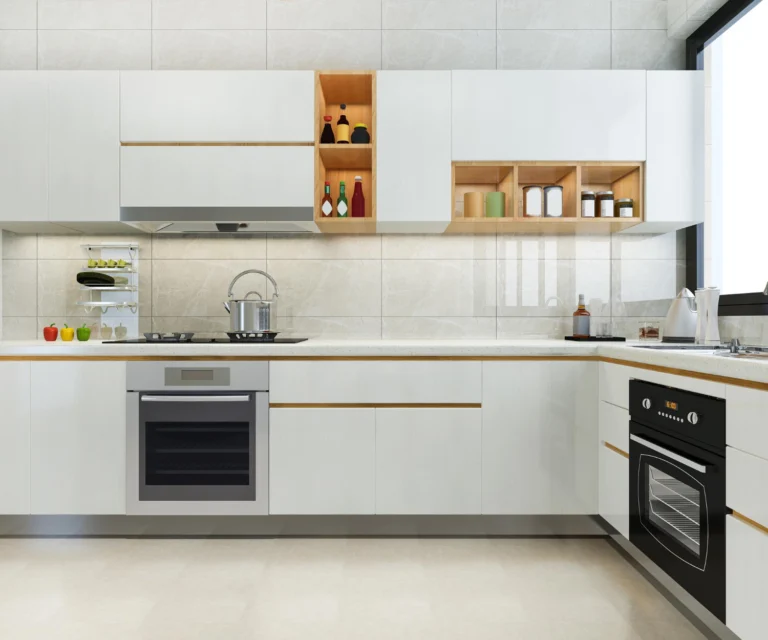
An L-shaped kitchen is often the most functional layout for open-plan homes because it uses two connected walls while leaving the room open for dining, seating, or an island. It works especially well in California, Texas, Florida, and other areas where open living spaces are popular.
The L-shape wins because it does not overcomplicate the room.
You usually place cabinets and appliances on two perpendicular walls. One leg handles cooking and prep. The other holds the sink, dishwasher, refrigerator, or pantry storage. This leaves the middle open.
That open middle is the reason L-shaped kitchens feel relaxed. They let parents cook while watching kids. They let guests talk without standing inside the work zone. They also fit many contractor budgets because they often keep plumbing and electrical on existing walls.
Competitors mention this, but many stop at “open and versatile.” The real value is that an L-shape gives you choices.
You can add:
- A small dining table
- A rolling cart
- A narrow island
- A pantry wall
- A beverage station
- A built-in banquette
Houzz’s 2026 kitchen study found that more than three-quarters of renovating homeowners add built-in features, with pantry cabinets at 47 percent and beverage stations at 24 percent. (Houzz)
That trend favors L-shaped kitchens because one wall can become a true storage wall.
When I Prefer L-Shaped Kitchens
I prefer L-shaped kitchens when the homeowner says, “We want the kitchen to feel connected.”
That sentence matters.
A U-shape can cook better. An island can host better. But an L-shape often lives better. It lets the kitchen breathe.
Use an L-shape when:
- The kitchen opens to a living or dining room
- Two people cook casually, not professionally
- You want a table or island nearby
- You need better flow to a patio or backyard
- Your budget cannot support major wall changes
- You want a cleaner resale-friendly layout
The L-Shaped Kitchen Mistake I See Often
The common failure is placing the refrigerator too far away.
A long L-shaped kitchen can stretch the work triangle until the cook walks back and forth all evening. The NKBA guideline says the three main work-center distances should total no more than 26 feet, with each leg between 4 and 9 feet.
Keep the refrigerator near the entry point, but not in the cooking path. That small choice can make the kitchen feel twice as smooth.

Is a U-Shaped Kitchen Better for Serious Cooking and Storage?
A U-shaped kitchen is better for homeowners who cook often, need storage, and want three strong work walls. It can be one of the Best Kitchen Layouts for Functionality when the center clearance is wide enough and corner cabinets are planned carefully.
A U-shaped kitchen is like a workshop.
Everything surrounds you. You turn, reach, chop, rinse, cook, and plate. That is why serious cooks often love it.
The danger is crowding.
In small homes, a U-shape can become a cabinet cave. Two people enter, and suddenly someone is trapped between the dishwasher and the oven door. Reddit users often describe this exact tradeoff, with some preferring U-shapes for storage and others warning about congestion. (Reddit)
The truth is both sides are right.
A U-shape is excellent when the room gives it enough space. It is frustrating when the room does not.
Best Uses for U-Shaped Kitchens
Choose a U-shaped kitchen when you need:
- Maximum base cabinet storage
- More landing space beside appliances
- Separate prep, cooking, and cleanup zones
- Better containment in a traditional floor plan
- A kitchen that supports baking or batch cooking
- Less visual clutter in nearby living spaces
For aging-in-place or accessible planning, this layout needs extra care. NKBA access guidance says a U-shaped kitchen should have at least 60 inches between opposing arms for wheelchair turning space.
That detail is missing from many competitor posts.
The Corner Cabinet Problem
Here is what nobody tells you at the start. U-shaped kitchens create more corners, and corners are expensive to solve well.
Cheap corner cabinets become black holes. You store the roasting pan there and see it again next Thanksgiving.
Better choices include:
- Blind-corner pullouts
- LeMans swing trays
- Lazy Susan units
- Corner drawers
- Appliance garages in dead corners
- Open shelves only where dust will not annoy you
My strong opinion: do not save money on U-shaped corner storage if storage is the reason you chose the layout. That is like buying a truck and refusing to use the bed.
Does an Island Kitchen Really Improve Functionality?
An island kitchen improves functionality only when the island has a clear job and enough aisle space. The best islands support prep, storage, seating, cleanup, or serving. A poorly sized island reduces function by blocking the work triangle and crowding appliance doors.
Islands are emotional.
People do not just want a counter in the middle of the room. They want the feeling of a better life. Saturday pancakes. Kids doing homework. Friends drinking coffee while dinner happens.
That is valid. Kitchens are emotional spaces.
But island planning must be ruthless.
A good island answers one clear question: what job does this island do?
Five Useful Island Jobs
| Island Job | Best Feature | Avoid |
| Prep island | Wide clear counter | Oversized sink that steals space |
| Storage island | Deep drawers | Shelves facing the work aisle |
| Seating island | Comfortable overhang | Stools in main traffic path |
| Cleanup island | Sink and dishwasher | Dirty dishes as the visual focal point |
| Cooking island | Cooktop and ventilation | Weak downdraft planning |
The 2026 NAHB code update matters here. In jurisdictions that adopted the unamended 2023 NEC, receptacles on island or peninsula sides can no longer be used to meet required countertop outlet provisions. NAHB says the change was driven by child safety concerns related to cords pulling appliances down. (National Association of Home Builders)
InterNACHI also notes that the 2023 NEC and 2024 IRC removed the requirement to install receptacles on islands and peninsulas based on countertop size, while still requiring provisions for future installation if no outlet is installed. (InterNACHI)
That means your 2026 island plan should involve your electrician early.
My Island Rule
If the island makes the kitchen photo better but the dinner routine worse, remove it.
A peninsula, slim worktable, or L-shape with a storage wall may serve you better.
Which Kitchen Layout Works Best for Small Homes and Condos?
For small homes, condos, ADUs, and older city properties, the best functional kitchen layout is usually an L-shape, galley, or compact peninsula. A full island only works if it keeps proper walkways and does not block appliance doors.
Small kitchens punish wishful thinking.
A homeowner may say, “We only need a small island.” But a small island still needs space around it. That is where many designs fail.
For compact kitchens, I usually rank layouts this way:
- L-shaped kitchen with tall pantry storage
- Galley kitchen with strong lighting
- One-wall kitchen with an island table
- Peninsula kitchen for seating
- U-shape only if the center space is generous
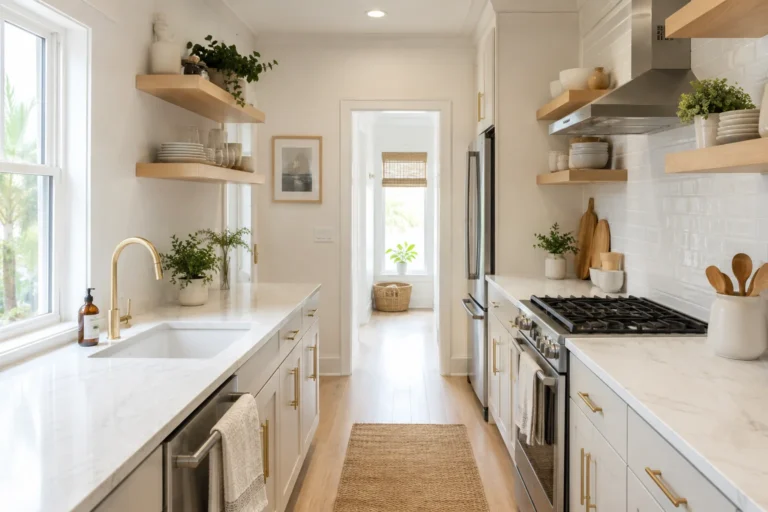
The L-shape often wins because it opens the center of the room. A galley can work beautifully when it is not a hallway for the whole house.
Small Kitchen Case Example
In one small condo-style plan, the owner wanted a 36-inch island. On paper, it looked possible. After appliance-door testing, the refrigerator and dishwasher could not open comfortably at the same time.
The better solution was a 24-inch-deep pantry wall, a 30-inch movable prep table, and drawers instead of lower doors.
The result was less dramatic, but more useful. That is the point.
Function beats drama.
Which Kitchen Layout Works Best for Large U.S. Family Homes?
For larger U.S. family homes, an L-shape with island or a wide U-shape with island usually provides the best mix of prep space, storage, seating, and traffic control. The right choice depends on whether the kitchen is mainly for cooking, hosting, or family routines.
Large kitchens create a different problem. The room can become too spread out.
A big kitchen with poor zones feels like an airport. Everything is technically there, but nothing is close.
For large suburban homes in Texas, Florida, Arizona, Georgia, and the Carolinas, I usually like an L-shape with a working island. It keeps the kitchen open to family spaces while giving the island a clear prep or seating role.
For older Northeast homes or Midwest homes with more defined rooms, a U-shape can work better. It respects the room shape and adds serious storage.
Large Kitchen Zoning Plan
A strong large kitchen needs:
- Prep zone near sink and trash
- Cooking zone with landing space
- Cleanup zone near dishwasher and dish storage
- Pantry zone near refrigerator
- Beverage zone outside the cooking path
- Seating zone away from appliance doors
This is where competitors often underdeliver. They compare shapes but ignore behavior.
A family kitchen is not a diagram. It is a rush-hour system.
How Much Space Do You Need Around a Kitchen Island?
You need at least 42 inches around working sides of a kitchen island for one cook and 48 inches for multiple cooks. For walkways, plan at least 36 inches. Seating areas need more space when people must pass behind stools.
This is the measurement section homeowners should screenshot before calling a contractor.
NKBA guidance recommends:
- 42 inches for a one-cook work aisle
- 48 inches for multiple cooks
- 36 inches for a walkway
- 32 inches behind seating with no traffic
- 36 inches to edge past seated diners
- 44 inches to walk past seated diners
- 60 inches where wheelchair passage is needed behind seating
For seating, NKBA recommends 24 inches of width per diner. Knee space depends on counter height. A 30-inch counter needs 18 inches, a 36-inch counter needs 15 inches, and a 42-inch counter needs 12 inches.
The Stool Problem
A 42-inch aisle behind stools sounds fine until someone sits down.
Then the stool moves back. A backpack lands on the floor. A dog lies in the walkway. Now the perfect plan is chaos.
If your island has seating, protect that space more than you think you need to.
What Is Better in 2026: Work Triangle or Work Zones?
The work triangle still matters, but work zones are more useful for modern kitchens. In 2026, the best kitchen layouts combine both: short travel between sink, cooktop, and refrigerator, plus dedicated zones for prep, cleanup, storage, coffee, trash, and seating.
The classic triangle connects sink, refrigerator, and cooking surface. It still works.
But modern kitchens do more. They host laptops, lunch boxes, air fryers, espresso machines, compost bins, pet bowls, and charging drawers.
That is why work zones are better for real life.
Use Both Systems
Use the triangle for:
- Sink
- Refrigerator
- Cooktop or range
Use zones for:
- Prep
- Cleanup
- Pantry
- Coffee
- Baking
- Beverage station
- Kids’ snacks
- Pet feeding
- Recycling and compost
NKBA also recommends a continuous prep area at least 36 inches wide and 24 inches deep near a sink.
That detail matters more than most style choices.
A beautiful backsplash will not help when you have nowhere to chop onions.
How Do 2026 Energy and Appliance Trends Affect Kitchen Layouts?
Energy and appliance trends now affect kitchen layouts because induction cooking, heat pump water heaters, panel-ready refrigeration, ventilation, and appliance garages need early space planning. The layout should be ready for efficient appliances before cabinets are ordered.
In 2026, a kitchen remodel is not just cabinets and counters.
It is electrical capacity, appliance location, ventilation, and long-term operating cost.
The U.S. Department of Energy says ENERGY STAR-certified electric stoves, cooktops, ranges, and ovens may qualify for rebates up to $840, depending on local programs. It also states induction appliances are up to three times more efficient than gas stoves. (The Department of Energy’s Energy.gov)
DOE also says heat pump water heaters can be two to three times more energy efficient than conventional electric resistance water heaters. They need suitable air volume and temperature conditions, which can affect adjacent utility, garage, or pantry planning. (The Department of Energy’s Energy.gov)
Layout Decisions This Changes
Plan early for:
- 240V induction wiring
- Vent hood duct routes
- Electrical panel capacity
- Refrigerator door swing
- Dishwasher clearance
- Heat pump water heater location
- Appliance garage outlets
- Island power compliance
- Countertop landing zones
ENERGY STAR lists certified product categories such as dishwashers, electric cooking products, freezers, and refrigerators, so appliance selection should be part of layout planning, not an afterthought. (ENERGY STAR)
What Kitchen Layout Is Best for Resale Value?
The best kitchen layout for resale is one that feels open, has strong storage, avoids awkward traffic, and does not over-improve beyond the local market. In most U.S. markets, buyers respond well to L-shape with island, functional U-shape, and bright storage-focused kitchens.
Resale value is not about copying luxury photos.
It is about removing buyer objections.
NerdWallet’s 2026 kitchen remodel guide reports that kitchen remodel costs range from about $28,500 for a minor remodel to over $160,000 for a major upscale remodel, based on a 2025 Cost vs. Value study accessed in 2026. (NerdWallet)
That range should calm people down.
Not every kitchen needs a six-figure rebuild. Often, the layout problem is smaller:
- Bad refrigerator placement
- Poor lighting
- No pantry storage
- Weak prep counter
- Island too large
- Trash in the wrong spot
- Dishwasher blocking cabinets
My Resale Opinion
For resale, the safest choice is usually not the most dramatic choice.
A clean L-shaped kitchen with an island, good lighting, pantry storage, and clear walkways will attract more buyers than a cramped “luxury” kitchen full of expensive friction.
NKBA’s 2026 kitchen trends report says homeowners value natural lighting, quality lighting, and task lighting for work zones at very high levels, with task lighting cited by 92 percent of respondents. (nkba.org)
Lighting is not decoration. It is functionality.
How Should Local Climate and Region Affect Kitchen Layout Planning?
Local climate affects kitchen layout because humidity, heat, snow, mud, outdoor cooking habits, and utility costs change how families use kitchens. A Florida kitchen may need stronger ventilation and moisture-smart materials, while a Midwest or Northeast kitchen may need mudroom and pantry adjacency.
Local SEO content often says, “serving your area,” then adds nothing useful.
Do better.
Regional kitchen planning should feel specific.
Florida and Gulf Coast Homes
Prioritize:
- Ventilation
- Moisture-resistant cabinetry
- Easy outdoor access
- Beverage storage
- Durable flooring
- Hurricane-season pantry space
California and Western Homes
Prioritize:
- Open-plan flow
- Indoor-outdoor connection
- Energy-efficient appliances
- Induction-ready wiring
- Compact storage in high-cost areas
Texas and Southern Suburbs
Prioritize:
- Large family islands
- Secondary beverage zones
- Walk-in pantry access
- Wide aisles for entertaining
- Heat-conscious appliance planning
Northeast and Midwest Homes
Prioritize:
- Mudroom connection
- Winter grocery drop zones
- Pantry cabinets
- Better task lighting
- Efficient closed-room U-shapes
This is one reason the Best Kitchen Layouts for Functionality vary by market. A beach home, mountain cabin, city condo, and suburban family kitchen do not need the same plan.
What Tools and Brands Help Plan a Functional Kitchen Layout?
The best kitchen planning tools help you test measurements, appliance clearances, storage needs, lighting, and cost before construction starts. Use design software, cabinet systems, and appliance specs together instead of relying on inspiration photos alone.
Here are practical tools and brands worth knowing.
| Tool or Brand | Best Use | Honest Note |
| IKEA Kitchen Planner | Budget layout testing | Great for rough planning, not final contractor drawings |
| SketchUp | Space modeling | Flexible, but has a learning curve |
| Chief Architect | Professional design | Strong for remodelers and designers |
| 2020 Design Live | Cabinet design | Industry-grade, often used by kitchen pros |
| Houzz | Inspiration and trends | Use carefully, photos can distort scale |
| NKBA Guidelines | Layout standards | Best for clearances and planning logic |
| ENERGY STAR Product Finder | Efficient appliance research | Useful before appliance selection |
| Bosch | Dishwashers and compact appliances | Good for quiet cleanup zones |
| KitchenAid | Appliance layout education | Helpful guides, brand-focused |
| Rev-A-Shelf | Cabinet organizers | Strong for corner and pullout storage |
| Blum | Hinges and drawer systems | Excellent for long-term cabinet function |
| LeMans corner units | Blind-corner access | Costs more, but solves real U-shape pain |
My advice: use inspiration tools for ideas, but use measurements to make decisions.
Pretty is allowed. Pretty cannot be the project manager.
What Common Kitchen Layout Mistakes Should Homeowners Avoid?
The most common kitchen layout mistakes are oversized islands, poor appliance door clearance, weak prep space, bad trash placement, missing lighting layers, and ignoring local electrical rules. These mistakes are expensive because they are often discovered after cabinets are installed.
Here are the failures I would fight hardest to prevent.
Mistake 1: Choosing the Island First
Start with the room, not the island.
Ask:
- Where do people enter?
- Where do groceries land?
- Where does trash go?
- Where does the dishwasher open?
- Where do kids sit?
- Where does the cook stand?
Mistake 2: Forgetting Landing Areas
NKBA recommends at least 24 inches of landing area on one side of the sink and 18 inches on the other. It also recommends cooking surface landing space of 12 inches on one side and 15 inches on the other.
That is not boring. That is safety.
Mistake 3: Putting the Sink in the Wrong Place
A sink in an island can work. But it also puts dirty dishes in the most visible place.
If you entertain often, consider keeping the main sink on the perimeter and using the island for prep and serving.
Mistake 4: Ignoring Trash Flow
Trash should be near prep and cleanup, not hidden across the kitchen.
A pullout trash cabinet beside the sink or prep counter often improves daily function more than a designer light fixture.
Which Layout Should You Choose Before Calling a Local Kitchen Contractor?
Before calling a local kitchen contractor, choose the layout that fits your room width, appliance locations, storage needs, and family traffic. Then ask the contractor to verify clearances, utilities, structure, ventilation, and code before final design.
Use this simple decision path.
Choose L-Shape If
- You want open-plan flow
- Your kitchen is small to medium
- You want an island later
- You need budget flexibility
- Your family gathers nearby
Choose U-Shape If
- You cook often
- You need storage
- You have enough center clearance
- You prefer a defined kitchen
- You can solve corner storage
Choose Island Layout If
- You have proper aisle space
- You want seating
- You need prep or storage
- Your kitchen opens to living space
- Electrical planning is possible
Choose Peninsula If
- You want island function without island space
- You need seating in a smaller kitchen
- You want to separate kitchen and living areas
- You need more counter without blocking the room
Best Kitchen Layouts for Functionality: Final Recommendation
For most homeowners, the most functional kitchen layout in 2026 is an L-shaped kitchen with a correctly sized island. For serious cooks, a U-shaped kitchen may perform better. For small homes, skip the island unless clearances prove it will work.
Here is the clean answer.
If your home is small, start with L-shape or galley.
If your home is medium and open, start with L-shape plus island.
If your home is large and cooking-focused, start with U-shape or U-shape plus island.
If your home needs seating but lacks island clearance, use a peninsula.
The Best Kitchen Layouts for Functionality are not chosen by trend. They are chosen by movement.
A functional kitchen lets you cook without bumping into people, unload groceries without crossing the room, open appliances without conflict, and clean up without creating a traffic jam.
That is what good design really means.
FAQs About Best Kitchen Layouts for Functionality
What is the most functional kitchen layout?
The most functional kitchen layout is usually an L-shape with a properly sized island because it supports prep, storage, seating, and open traffic. For serious cooking, a U-shaped kitchen may work better because it gives more counter space and storage.
Is an L-shaped kitchen better than a U-shaped kitchen?
An L-shaped kitchen is better for open-plan living and casual family flow. A U-shaped kitchen is better for storage and serious cooking. The better choice depends on room size, aisle clearance, and how many people cook at once.
Is a kitchen island worth it in a small kitchen?
A kitchen island is worth it only if it leaves proper walkways and does not block appliance doors. In many small kitchens, a peninsula, rolling cart, or slim prep table works better than a fixed island.
How much clearance do I need around a kitchen island?
Plan at least 42 inches around working sides for one cook and 48 inches for multiple cooks. Walkways should be at least 36 inches. Seating areas need more room when people pass behind stools.
What kitchen layout is best for resale?
An open L-shaped kitchen with island, good lighting, pantry storage, and clear appliance placement is often best for resale. Buyers usually value function, storage, and flow more than unusual custom features.
Are U-shaped kitchens outdated?
No. U-shaped kitchens are not outdated when they are planned with open sightlines, good lighting, smart corners, and enough center clearance. They feel outdated only when they are cramped, dark, or isolated from the home.
Should the sink go in the island?
A sink can go in the island if cleanup, plumbing, and visibility make sense. For many homeowners, keeping the main sink on the perimeter and using the island for prep creates a cleaner social space.
What is the biggest kitchen layout mistake?
The biggest mistake is adding an island without enough clearance. The second biggest mistake is ignoring appliance door swings. Both can make a new kitchen feel cramped even after a costly remodel.
What layout works best for two cooks?
Two cooks usually need wider aisles, separate prep zones, and storage near each task. L-shape with island and large U-shape layouts work well when each cook has a clear station.
How do I plan a kitchen before hiring a contractor?
Measure the room, mark doors and windows, list appliance sizes, note plumbing and electrical locations, and decide how your family uses the kitchen. Then ask a contractor or designer to verify layout, code, and cost.
2026 Material Watch
Smart Glass
Smart glass can help kitchens with large windows control glare, privacy, and heat. It is especially useful in sunny markets where open-plan kitchens face patios or pools.
Heat Pump Integration
Kitchen remodels increasingly connect with whole-home energy planning. If you are upgrading to induction, better ventilation, or a heat pump water heater, plan electrical capacity and utility placement early.
Recycled Steel Framing
Recycled steel framing may become more common in kitchen additions, structural openings, and remodels that remove walls. It supports durability and can fit future-focused building goals.
Low-Carbon Countertops
Quartz, quartzite, sintered stone, recycled glass, and other lower-maintenance surfaces are gaining attention because homeowners want durability without constant sealing.
Panel-Ready Appliances
Panel-ready refrigerators and dishwashers support cleaner visual lines, but they need precise cabinet planning. Decide on them before cabinet drawings are finalized.