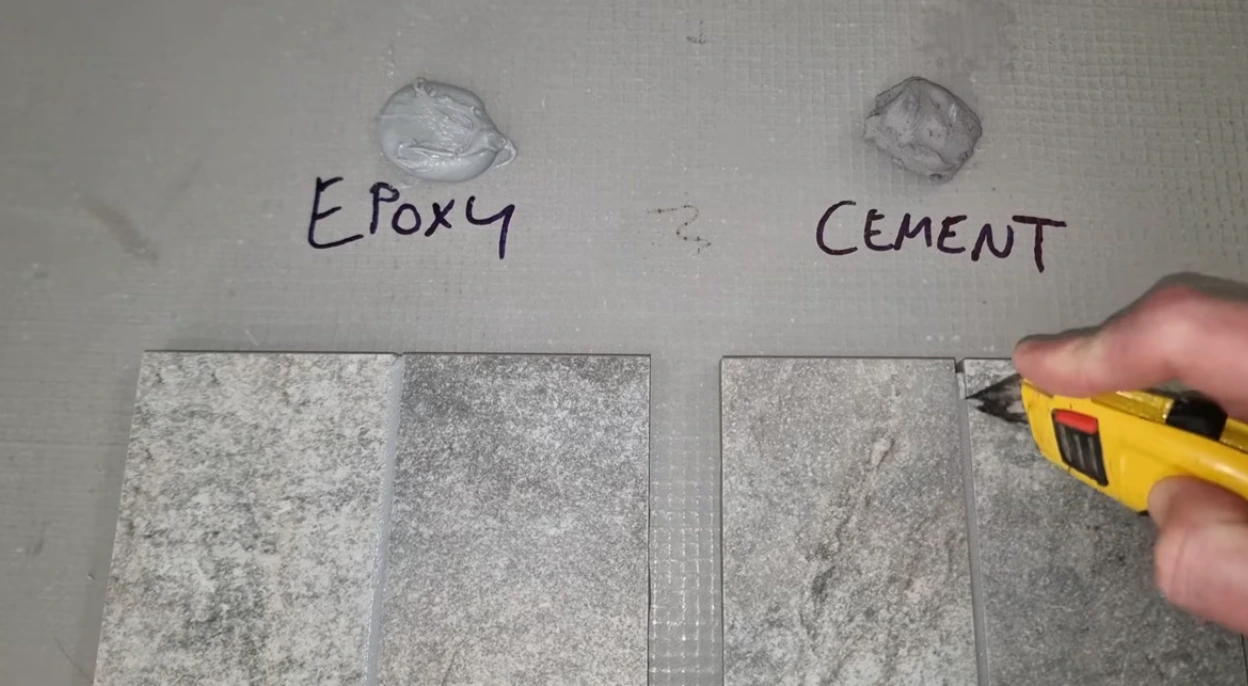
Epoxy Grout vs Cement Grout: The Better Choice for a South Florida Bathroom
Quick Answer
For most Boca Raton showers, epoxy grout is the better choice because it resists moisture, staining, and mold more effectively than cement grout. However, neither product replaces proper waterproofing, ventilation, and professional installation.
A Boca Raton shower can look dry ten minutes after use. The grout may still be holding moisture below the surface.
That matters in South Florida. Warm air, long cooling seasons, daily showers, and weak ventilation can keep bathrooms damp. The wrong grout will not cause every moisture problem, but it can make cleaning and staining far worse.
The practical answer is simple. Epoxy grout handles repeated bathroom moisture better than standard cement grout. However, grout never replaces a correct waterproofing membrane, sound tile setting, or working exhaust fan.
Key takeaways for epoxy grout vs cement grout
Epoxy grout is usually the better choice inside a Boca Raton shower. It absorbs far less water, resists stains, and does not need a penetrating sealer. High-performance cement grout remains useful in dry bathroom areas and budget-led projects.
- Choose epoxy for shower floors, niches, benches, and busy family bathrooms.
- Choose ANSI A118.7 cement grout for dry walls and lower-use bathroom floors.
- Never treat grout as the shower’s waterproofing layer.
- Use flexible silicone at corners and changes of plane.
- Control indoor humidity and vent shower moisture outdoors.
- Hire an installer who can show completed epoxy grout work.
Who will benefit from this guide?
This guide is designed for homeowners comparing materials before hiring a contractor. It also helps property managers and condo owners who face repeated grout staining.
- Boca Raton homeowners planning a bathroom remodel
- East Boca condo owners replacing stained shower grout
- Landlords seeking lower-maintenance bathroom finishes
- Buyers inspecting an older tiled shower
- Homeowners comparing regrouting with full shower replacement
- Contractors explaining grout choices to South Florida clients
| Feature | Epoxy Grout | Cement Grout |
|---|---|---|
| Water Resistance | Excellent | Moderate |
| Stain Resistance | Excellent | Fair |
| Mold Resistance | Better | Moderate |
| Maintenance | Low | Medium |
| Cost | Higher | Lower |
| Shower Use | Best Choice | Acceptable |
| Lifespan | Longer | Shorter |
Which grout handles South Florida bathroom moisture better?
Epoxy grout handles South Florida bathroom moisture better than cement grout. Its dense resin system limits absorption and reduces deep staining. Cement grout can still perform well when installed, cured, sealed, and maintained correctly.
That answer needs one important limit. No grout makes a shower assembly waterproof. The Tile Council of North America explains that cement grout can transmit water and vapor. Major shower-system makers also state that tile and grout are not the primary waterproofing layer.
In other words, epoxy improves the exposed surface. A membrane protects the wall or floor below it. You need both parts to do their jobs.
| Bathroom condition | Better choice | Why |
| Daily-use shower floor | Epoxy grout | Low absorption and easier cleaning |
| Shower niche or bench | Epoxy grout | Frequent standing water and product spills |
| Guest powder room wall | Cement grout | Low moisture and lower cost |
| Main bathroom floor outside shower | Either | Traffic, tile type, and maintenance decide |
| Natural stone shower | Product-specific choice | Resin may affect some porous stone |
| Moving corner joint | Neither | Use compatible flexible silicone |
What is the real difference between epoxy grout and cement grout?
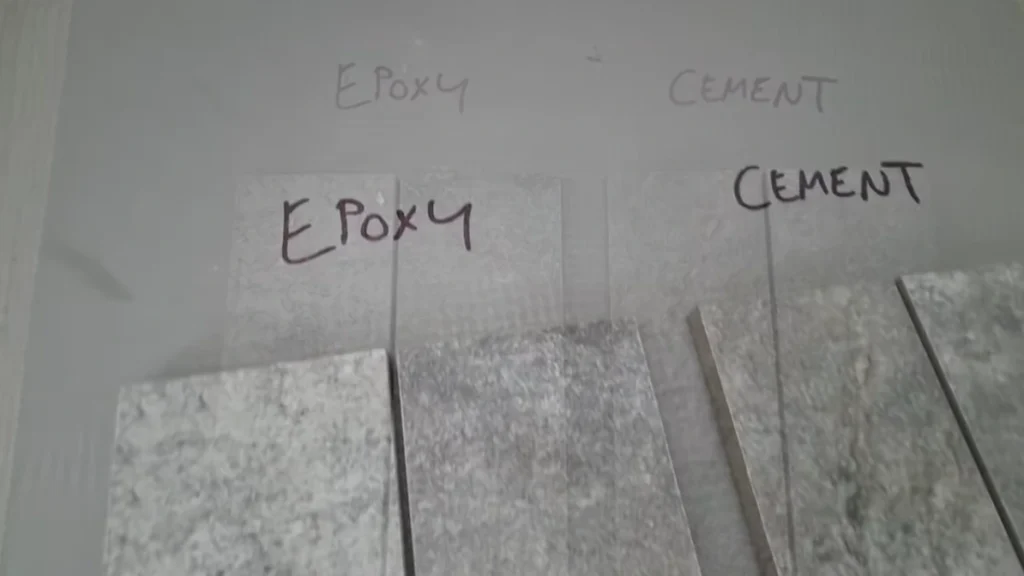
The main difference is the binder. Cement grout hardens through cement hydration. Epoxy grout cures through a chemical reaction between resin and hardener.
Cement grout contains Portland cement, pigments, fillers, and often polymers. Standard versions remain porous after curing. Premium cement grouts reduce absorption, color variation, shrinkage, and efflorescence.
Epoxy grout uses resin, hardener, and colored aggregate. It forms a dense joint with strong stain and chemical resistance. Many products meet the ANSI A118.3 performance standard for chemical-resistant epoxy grout.
How does high-performance cement grout change the comparison?
Modern cement grout deserves more credit than old builder-grade grout. Products such as MAPEI Ultracolor Plus FA, Custom Prism, and Custom Polyblend HP meet stronger performance targets than basic cement grout.
For example, ANSI A118.7 high-performance cement grout has lower absorption limits than standard cement grout. It also offers better strength and color control. Still, it does not become epoxy.
This middle option is often missed in basic epoxy grout vs cement grout articles. Homeowners do not face only two extremes. A premium cement grout can be a sensible value choice outside the wettest zones.
Is epoxy grout waterproof enough to stop a shower leak?
No. Epoxy grout should not be used as a leak repair or waterproofing substitute. It is highly water resistant, but the shower must have a complete waterproofing system behind the tile.
This is the most important competitor gap. Many comparison pages call epoxy waterproof without explaining the assembly. LATICRETE states that no grout provides the required waterproofing by itself.
A correct tiled shower may include a sloped shower base, bonded membrane, sealed penetrations, compatible drain, thin-set mortar, tile, grout, and flexible sealant. One failed layer can create damage that a harder grout cannot cure.
Read our Boca Raton shower waterproofing guide before approving a tile proposal. Also review the TCNA list of current ANSI tile standards.
Why does Boca Raton humidity change the grout decision?
Boca Raton’s warm, humid climate increases the value of low-maintenance wet-area materials. Outdoor humidity is not the only issue. Shower steam, closed doors, undersized fans, and long air-conditioning cycles also affect drying.
The CDC recommends keeping indoor humidity no higher than 50 percent when possible. The EPA also recommends bathroom exhaust fans that vent outdoors. These steps reduce condensation and mold risk.
Epoxy grout does not feed mold. However, soap film, skin oils, and shampoo residue can collect on any surface. Mold can grow on that dirt even when the grout below is nonporous.
Does coastal salt air damage indoor bathroom grout?
Salt air is rarely the main cause of indoor shower grout failure. Direct moisture, poor ventilation, movement, and cleaning habits matter more.
Coastal conditions can still influence metal trim, fasteners, fan housings, and nearby exterior openings. In an East Boca condo, inspect the full room rather than blaming every dark line on grout.
Epoxy grout vs cement grout: Which resists mold and stains better?
Epoxy grout resists deep staining and mold attachment better. Its low-porosity surface gives moisture and residue fewer places to settle. Cement grout can absorb colored products and dirty water when its protection wears down.
Do not promise a mold-proof shower. No grout stays clean without basic care. A pink or orange film often reflects surface bacteria and soap residue, not failure inside the grout.
Use a pH-neutral tile cleaner for routine care. Avoid switching between strong acid and alkaline products without checking the grout and tile maker’s instructions.
- Squeegee shower walls after use.
- Run the exhaust fan during bathing.
- Keep the fan running after the shower.
- Wash corners and silicone joints regularly.
- Repair plumbing leaks quickly.
- Dry wet materials within 24 to 48 hours.
For a maintenance plan, see our guide to preventing mold in South Florida bathrooms.
Does epoxy grout crack less than cement grout?
Epoxy grout resists shrinkage well, but it can still crack when the tile assembly moves. Strong grout cannot correct loose tile, weak framing, poor mortar coverage, or a moving substrate.
Corners are a common failure point. The wall-to-wall and wall-to-floor junctions should normally receive a flexible sealant that matches the system. Filling a moving corner with rigid grout can produce an attractive crack line months later.
This leads to a contrarian point. The strongest grout is not always the best material for every joint. Movement joints need flexibility, not more hardness.
What causes repeated cracks after regrouting?
Repeated cracking usually signals a deeper problem. Common causes include substrate movement, hollow tile, poor mortar bond, missing movement joints, or water-damaged backing.
Do not keep packing fresh grout into the same crack. Ask for a cause assessment first. Our cracked shower grout troubleshooting guide explains the inspection steps.
When is cement grout the smarter choice?
Cement grout is the smarter choice when moisture exposure is low, the budget is tight, or the tile needs a traditional matte joint. A quality ANSI A118.7 product can perform well in many bathroom areas.
Consider premium cement grout on a powder-room wall, dry vanity backsplash, or lightly used guest bath floor. It is also easier for many installers to place and clean.
Cement grout may suit porous natural stone when the epoxy maker warns about resin staining. Always build a sample board before grouting limestone, marble, travertine, metal tile, or textured tile.
Choose cement grout when these points apply:
- The surface stays outside the shower spray zone.
- The installer is stronger with cement systems.
- The tile maker limits epoxy use.
- A soft matte look is important.
- The homeowner accepts sealing and maintenance.
- Future spot repair matters more than maximum stain resistance.
How much does epoxy grout vs cement grout cost over time?
Epoxy grout is worth the premium in small, wet, joint-heavy areas. Shower mosaics create far more grout lines than large porcelain tile. That makes low absorption especially valuable.
Material prices vary by kit size and color. In June 2026, basic cement grout bags were often listed below $20 at major retailers. Several epoxy grout kits were listed around $70 to more than $100.
Labor may create the larger price gap. Epoxy requires measured mixing, small work sections, quick washing, and careful haze control. A low bid from an inexperienced installer can become the most expensive option.
A simple 10-year value check
Do not compare only one bag with one kit. Compare the full service life.
| Cost factor | Epoxy grout | High-performance cement grout |
| Initial material | Higher | Lower |
| Installation skill | Higher | Moderate |
| Penetrating sealer | Usually not needed | May be recommended |
| Routine cleaning | Usually easier | Often more scrubbing |
| Color stability | Strong | Product and care dependent |
| Future spot repair | Harder | Usually easier |
| Risk of installation haze | High if mishandled | Moderate |
Ask contractors to separate material, labor, removal, repair, silicone, and cure time. That makes quotes easier to compare.
See our Boca Raton bathroom remodeling cost guide for a complete budget framework.
Which epoxy grout vs cement grout products should Boca Raton homeowners compare?
Compare products by standard, tile compatibility, joint width, cure schedule, and installer experience. Brand recognition alone does not guarantee the right installation.
The products below are common reference points. Availability and formulas can change, so confirm the current technical data sheet before purchase.
| Product | Type | Strong point | Watch point |
| LATICRETE SPECTRALOCK PRO Premium | Epoxy | Low absorption and color consistency | Requires disciplined cleanup |
| MAPEI Kerapoxy CQ | Epoxy | Stain resistance and broad color range | Test textured and porous tile |
| Custom CEG-Lite | Epoxy | Lighter spreading than older epoxies | Follow batch and wash timing |
| Custom CEG-IG | Industrial epoxy | High chemical and strength performance | Often more than a home shower needs |
| ARDEX WA | Epoxy | Commercial wet-area performance | Skilled installation still matters |
| MAPEI Ultracolor Plus FA | Cement | Fast-setting, fine aggregate, no sealer claimed | Remains a cement-based joint |
| Custom Prism | Cement | ANSI A118.7 performance | Water control during mixing is critical |
| Custom Polyblend HP | Cement | Wider joint range and color consistency | Verify local stock and cure rules |
| Bostik Vivid | Cement | Strong color and stain features | Check tile and joint compatibility |
| TEC Power Grout | Cement | High-performance residential option | Follow cleaning limits closely |
This is not a ranking. The best product is the one that fits the tile, assembly, and installer. Read our bathroom tile material checklist before selecting a final system.
What should you ask an epoxy grout installer?
Ask for proof of process, not a simple yes or no. An installer may have used epoxy once and still lack the speed needed for a detailed shower.
A useful interview takes less than ten minutes. The answers can prevent permanent haze, low joints, pinholes, and mismatched batches.
- Which epoxy grout systems do you use most often?
- Can I see two completed showers with close-up photos?
- How do you divide the work into batches?
- Who applies grout and who handles the wash?
- How will you protect textured or porous tile?
- What product will you use at corners and changes of plane?
- How long before the shower returns to service?
- What happens if haze appears after curing?
- Does your warranty cover grout installation defects?
- Will the proposal follow the grout maker’s data sheet?
For hiring help, use our Boca Raton bathroom contractor checklist.
Can epoxy grout be installed over old cement grout?
Usually, the old grout must be removed to create enough clean joint depth for a durable bond. A thin cosmetic skim over dirty cement grout is not a dependable repair.
The required removal depth depends on the product and tile joint. Fine Homebuilding describes removing existing grout to meaningful depth before epoxy regrouting. Product makers may set different preparation rules.
Old grout must also be dry, firm, and free from soap, oil, sealer, and cleaning residue. If tiles move or backing feels soft, stop. Regrouting will hide the symptom without fixing the failure.
When should you replace the shower instead of regrouting?
Regrouting makes sense when tile is firmly bonded and the waterproofing is not showing failure. Full repair may be safer when tiles are loose, walls feel soft, odors return, or damage appears outside the shower.
Use our regrout or retile decision guide before paying for a surface-only fix.
How should epoxy grout and cement grout be cleaned?
Use the mildest cleaner that removes the soil. Stronger chemicals are not a substitute for regular drying and ventilation.
Epoxy grout often cleans with warm water and a pH-neutral product. Cement grout may need a grout-safe alkaline cleaner for body oils. Acidic products can damage cement-based materials and some stone.
Never mix bleach with ammonia or acids. Test a small area first. Follow the tile, grout, and cleaner instructions.
| Cleaning task | Recommended starting point |
| Weekly shower cleaning | pH-neutral tile cleaner |
| Soap film | Grout-safe alkaline cleaner |
| Hard-water deposits | Tile-specific product after compatibility test |
| Epoxy installation haze | Maker-approved epoxy haze remover |
| Natural stone | Stone-safe cleaner only |
| Recurring mold | Fix moisture source, then clean safely |
See our safe tile and grout cleaning guide for product selection.
What ventilation changes matter more than grout choice?
A good exhaust system can matter more than upgrading grout. The fan must move enough air and discharge outdoors. A loud fan that nobody uses offers little value.
The current Florida Building Code in mid-2026 is the 8th Edition from 2023. The 9th Edition is scheduled to take effect on December 31, 2026. Its energy provisions add new mechanical ventilation testing and bathroom exhaust control language.
For local permit questions, use the City of Boca Raton Building Permits and Inspections portal. Work that changes plumbing, electrical systems, walls, or shower waterproofing may need review.
Practical moisture controls include:
- Use a timer or humidity-sensing fan control.
- Confirm the duct terminates outdoors.
- Clean the fan grille and duct path.
- Leave the shower door open after use.
- Keep indoor humidity near the CDC target.
- Repair toilet, valve, and drain leaks promptly.
Our bathroom ventilation guide for South Florida homes covers fan sizing and placement.
Three South Florida bathroom scenarios
These examples are illustrative, not claimed client case studies. They show how the decision changes with use, tile, and failure type.
Scenario 1: East Boca condo shower with small mosaics
A daily-use shower has two-inch floor mosaics and pale grout. The many joints collect soap and stay wet longer than large tile.
Epoxy grout is the stronger choice after the installer verifies the waterproofing and tile bond. A matching 100 percent silicone belongs at movement joints.
Scenario 2: Boca West guest bathroom
A lightly used guest bath has porcelain floor tile outside a tub surround. Moisture exposure is limited, and the owner wants a matte finish.
An ANSI A118.7 cement grout can be a sound value choice. The owner should follow the maker’s cleaning and sealing guidance.
Scenario 3: Cracked corner near Mizner Park
A shower corner has been regrouted twice. The straight crack returns because two planes move independently.
The correct repair may be grout removal and flexible sealant, not stronger grout. If tile moves, the assembly needs further inspection.
Epoxy grout vs cement grout: What is the final verdict?
Choose epoxy grout for the wettest, hardest-to-clean parts of a Boca Raton bathroom. Choose high-performance cement grout for dry or lightly used areas where price, appearance, and repairability matter more.
The best epoxy grout vs cement grout plan may use both. Epoxy can protect the shower floor and niche. Premium cement grout can finish a dry bathroom floor or vanity wall.
However, do not let the grout debate distract from bigger risks. Waterproofing, mortar coverage, slope, drain details, movement joints, ventilation, and plumbing quality decide whether the bathroom stays dry.
Before signing a proposal, request the product data sheets and a written assembly description. Then compare the contractor’s answer with our complete bathroom remodeling planning guide.
Frequently asked questions about epoxy grout vs cement grout
Is epoxy grout better than cement grout for a shower?
Yes. Epoxy usually offers better water, stain, and chemical resistance. It also avoids routine penetrating sealer. Correct waterproofing and skilled installation remain essential.
Does epoxy grout prevent mold forever?
No. Epoxy limits absorption, but surface residue can still support mold or bacteria. Keep the shower clean, dry, and well ventilated.
Does cement grout always need sealing?
Not every modern cement grout maker requires sealing. Check the technical data sheet. Sealer can reduce absorption, but it does not waterproof the shower assembly.
How long does epoxy grout take to cure?
Cure times vary by product, temperature, and exposure. Some showers return to light service quickly, while submerged uses need longer. Follow the exact data sheet.
Can epoxy grout stain marble or natural stone?
Yes, some resins or fillers can affect porous stone. Build a sample first. Seal the tile when the manufacturer recommends it.
Can epoxy grout be used on shower floors?
Yes. Shower floors are one of its strongest uses. Confirm slip-resistant tile, correct slope, drain detailing, and compatible joint width.
Why does epoxy grout look shiny?
Older formulas often had a plastic-like sheen. Newer products offer softer finishes, but appearance still varies. Approve a cured sample board first.
Is epoxy grout harder to remove later?
Yes. Its strength makes removal slower and raises the risk of tile-edge damage. That durability is helpful in service but costly during future repair.
Can a homeowner install epoxy grout as a DIY project?
A careful homeowner can, but the risk is higher than cement grout. Fast batching and washing matter. Practice on a sample panel before touching the shower.
What grout color hides bathroom dirt best?
Mid-tone gray or beige usually hides routine discoloration better than bright white or black. Color should also match the tile and cleaning plan.
Should shower corners use grout or silicone?
Use a compatible flexible sealant where the tile system requires movement accommodation. Rigid grout often cracks at changes of plane.
Do I need a permit to regrout a shower in Boca Raton?
Simple surface regrouting may not need a building permit. Work that changes plumbing, electrical parts, walls, or waterproofing may require one. Confirm with Boca Raton Development Services.
2026 Material Watch
New grout systems are moving toward lower absorption, easier cleanup, and reduced environmental impact. Watch for hybrid resin grouts, recycled-glass aggregates, low-VOC epoxy systems, and faster return-to-service formulas.
Also expect better color-matched silicone and more humidity-sensing ventilation controls. These products will not replace careful installation. They will make good bathroom systems easier to maintain.