Key Takeaways
- A prefab shower pan is usually quicker to install, easier to clean and more budget-friendly.
- A custom tile shower pan offers greater design flexibility, including unique layouts and curbless shower possibilities, but requires more skilled labor.
- Neither option is automatically leakproof. Correct drainage, waterproofing and installation are essential.
- A tile-ready prefabricated base offers a middle ground between a finished shower pan and a traditionally built tile floor.
- Compare complete installation quotes, not just material prices, before choosing.
The best shower pan depends on your budget, bathroom layout, maintenance preferences and design goals.
What Is the Difference Between a Prefab Shower Pan and a Custom Tile Pan?
When exploring shower pan options, homeowners usually compare a factory-made shower base with a shower floor constructed and finished on-site. Both can create an attractive, functional shower, but they differ in installation, appearance, maintenance and design flexibility.
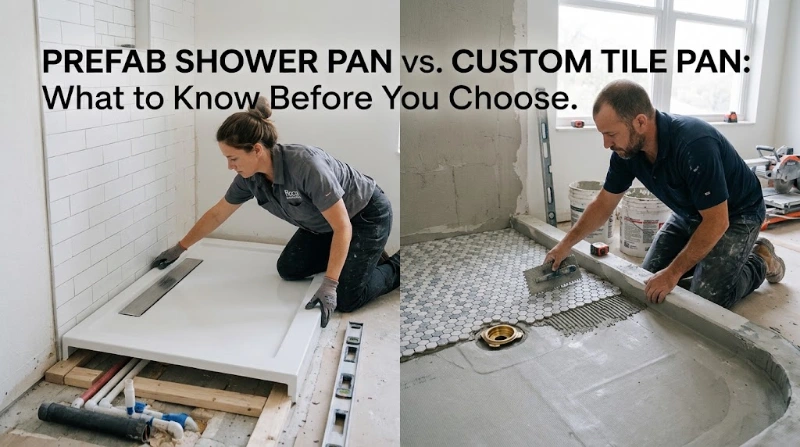
A prefabricated shower pan is a manufactured base, commonly made from acrylic, fiberglass or a composite material. It arrives with its drainage surface already formed and is designed for a compatible shower layout.
A custom tile shower pan is built for the specific shower space. Its sloped base, waterproofing system, drain assembly and tile finish must work together as one system.
There is also a third option: a prefabricated, tile-ready shower tray. This manufactured base is designed to receive tile rather than serve as the finished walking surface. It can simplify parts of the construction process while preserving the appearance of a tiled shower floor.
Understanding this distinction matters because a finished acrylic pan, a tile-ready tray and a traditional mortar-bed pan have different installation requirements.
Prefab Shower Pan vs. Custom Tile Pan: Pros and Cons
| Factor | Prefabricated finished pan | Custom tile pan |
|---|---|---|
| Upfront cost | Usually lower | Usually higher |
| Installation | Generally faster | Requires more labor and curing time |
| Appearance | Smooth, consistent finish | Extensive tile and pattern choices |
| Cleaning | No floor grout joints to scrub | Grout joints require routine cleaning |
| Layout flexibility | Limited by available sizes and drain positions | Can accommodate more layouts |
| Accessibility | Low-threshold options are available | Curbless designs may be possible with additional planning |
| Main risk | Poor support, drain connections or wall-joint sealing | Incorrect slope, waterproofing or drain integration |
These are general comparisons. A premium solid-surface pan can cost considerably more than a basic fiberglass model, and a well-installed custom shower can outperform a poorly installed prefabricated system.
When a Prefabricated Shower Pan Makes Sense
A prefab pan is worth considering if you want a practical shower with a predictable finish and fewer on-site construction steps.
Its main advantages include:
- Faster installation: The finished base is manufactured in advance, reducing the amount of work needed to create the shower floor.
- Simpler cleaning: The continuous surface has no tiled floor grout joints, although the drain and perimeter joints still need regular care.
- More predictable sizing: Standard dimensions and drain configurations can simplify planning when they suit the existing bathroom.
- A range of materials: Acrylic, fiberglass, composite and solid-surface products offer different appearances, costs and performance characteristics.
- Potentially lower project costs: Less custom floor construction and tile labor can make a prefabricated base a practical choice.
The trade-off is that you must work within the product’s available dimensions, shape and drain location. Some pans may also feel less substantial underfoot or show scratches and wear, depending on their material and construction.
A prefab base is often a sensible choice for a guest bathroom, a rental property or a straightforward replacement where the existing layout works well.
When a Custom Tile Shower Pan Makes Sense
A custom tile pan is appealing when the shower needs to fit a particular design rather than an available manufactured size.
Its main advantages include:
- Design freedom: You can coordinate the shower floor with the rest of the bathroom using suitable tile colors, patterns and finishes.
- More layout possibilities: Custom construction can accommodate unusual dimensions and certain complex shower shapes.
- Integration with luxury features: A tiled floor can complement a linear drain, custom glass enclosure, built-in bench or carefully planned shower niche.
- Curbless design potential: A properly engineered system may allow a flush entry, subject to the existing floor structure, drainage design and applicable requirements.
However, custom construction takes more planning and skilled labor. The installer must create the correct slope, integrate the waterproofing system with the drain and transitions, and install tile that suits the floor’s shape.
Tile selection also matters. Small-format mosaics can accommodate sloped surfaces more easily than many large-format tiles, but the appropriate size depends on the product and installation system. Always follow the manufacturer’s specifications.
Custom tile is generally the better fit when appearance, layout flexibility and a coordinated bathroom design are higher priorities than minimizing installation time.
How Much Does Each Shower Pan Option Cost?
The price difference depends on whether you are replacing the pan alone or remodeling the entire shower.
As a national reference, This Old House’s 2026 cost guide estimates shower pan installation at approximately $220–$3,500, assuming no major plumbing work. Its walk-in shower guide places basic prefabricated installations around $4,000–$7,000, midrange tiled showers around $8,000–$13,000, and high-end custom showers around $14,000–$20,000 or more. These figures describe different project scopes and should not be compared as though they were equivalent quotes.
Your actual price can change significantly with the shower’s dimensions, selected materials, demolition, plumbing work, glass enclosure and any hidden damage discovered after removal.
For homeowners in Boca Raton, a useful estimate should identify:
- Removal and disposal of the existing shower base.
- The new pan or tile-ready base and compatible drain.
- Subfloor preparation and structural repairs, if needed.
- Waterproofing and installation labor.
- Wall tile, grout, sealants and related finishing work.
- Glass doors, fixtures and plumbing changes.
- Applicable permits and inspections.
A lower initial quote is not necessarily the better value if essential waterproofing, repairs or finishing work is excluded.
Waterproofing: The Most Important Part of Either Installation
A shower can look excellent and still develop a leak if its underlying construction is wrong.
With a finished prefab pan, the base itself provides the finished shower floor. The installer must still provide proper support, connect the drain correctly and detail the transition between the pan and surrounding walls according to the manufacturer’s instructions.
With a tiled shower, the waterproofing system must be designed as part of the complete assembly. The sloped substrate, membrane, drain connection, corners and transitions must work together before the tile is installed.
Tile and grout alone are not a waterproofing system. Water can pass through grout joints, so the underlying assembly must manage moisture and direct it toward the drain.
The Florida Building Code’s residential plumbing provisions address shower-receptor construction, drainage slope and waterproofing. The applicable edition, local amendments and permit requirements should be confirmed for the specific project. See the 2023 Florida Building Code, Residential.
For systems that require a water or flood test, ask the contractor when the test will take place and whether the result will be documented. Schluter, for example, recommends testing its shower system before tile installation to help verify that the assembly is watertight. The manufacturer’s instructions and applicable local requirements determine the correct procedure.
In short, don’t choose a pan based on appearance alone. Ask how it will be supported, waterproofed and connected to the drain.
Cleaning, Maintenance and Long-Term Use
Maintenance is another important factor when comparing shower pan options.
A smooth acrylic or composite pan is usually straightforward to wipe down. Because the floor has no tile grout joints, there are fewer floor joints to scrub. However, the surface can still accumulate soap residue, and the drain and perimeter sealant require routine attention. Use cleaners approved for the specific material.
A tiled shower floor offers more design flexibility, but its grout joints need regular cleaning. Whether grout requires sealing depends on the grout type and the manufacturer’s recommendations; natural stone may have additional care requirements. Flexible sealant at changes of plane also needs inspection and eventual replacement when it deteriorates.
Neither option eliminates maintenance entirely. Good ventilation, appropriate cleaning products, properly functioning drainage and prompt attention to damaged sealant help keep either shower in good condition.
Can You Combine a Prefab Pan With Tile Walls?
Yes. A prefabricated shower base with tiled walls is a practical middle-ground option.
The finished base provides a manufactured floor surface, while tile gives the walls a more customized appearance. This approach can reduce the amount of work involved in constructing a tiled floor without requiring a fully prefabricated shower surround.
The important detail is the connection between the base and the wall assembly. The wall waterproofing, base flange or other specified connection, and finishing details must be compatible with the chosen product.
This option may suit homeowners who want a more customized bathroom without the added labor of a custom tiled floor. It is worth discussing alongside fully prefabricated and fully tiled designs.
Which Shower Pan Is Best for Your Bathroom?
The right choice comes down to how you use the bathroom and what you want the finished space to accomplish.
Choose a prefabricated finished pan if your priority is straightforward cleaning, a quicker installation and a more controlled budget. It is especially attractive when a standard size and drain location fit the existing layout.
Choose a custom tile pan if you want a distinctive design, an unusual shower footprint or a tiled floor that coordinates with a larger bathroom renovation. Be prepared for more planning, labor and attention to waterproofing details.
Consider a tile-ready prefabricated tray if you want a tiled floor but would like to use a manufactured base designed for that purpose.
If you are planning a complete bathroom upgrade, explore bathroom remodeling in Boca Raton to consider how the shower base fits into the wider renovation. Homeowners planning a premium design can also review luxury bathroom remodeling in Boca Raton.
If the project involves replacing a bathtub with a shower, see the options for a tub-to-shower conversion in Boca Raton. If you intend to keep the bathtub, bathtub replacement services may be more appropriate.
Questions to Ask Before Hiring a Shower Installer
Before approving a quote, ask the contractor:
- Is the proposed base a finished prefab pan, a tile-ready tray or a site-built pan?
- Which product and drain system will be installed, and are they compatible?
- How will the base be supported and the floor sloped for drainage?
- What waterproofing system will be used, and how will it connect to the drain and walls?
- Will a water or flood test be required, and will the result be documented?
- Does the estimate include demolition, repairs, tile, glass, plumbing, permits and finishing?
- What workmanship and product warranties apply?
Clear answers make it easier to compare proposals and understand what you are paying for.
Frequently Asked Questions
Is a prefab shower pan better than a tiled shower floor?
Neither is universally better. A prefab pan generally offers simpler cleaning and faster installation. A custom tile pan provides greater design flexibility but requires more labor and careful waterproofing. The best choice depends on your bathroom layout, budget and maintenance preferences.
Does a tiled shower pan leak more easily?
Not necessarily. A properly designed and installed tiled shower can perform well for many years. Problems arise when the slope, waterproofing membrane, drain connection or other critical details are incorrect. Tile and grout should not be relied upon as the primary waterproofing layer.
Which shower pan is easiest to clean?
A smooth, finished prefab pan is generally easier to clean because it has no tiled floor grout joints. A tiled floor can also be maintained successfully, but grout and any natural-stone surfaces may require additional care.
Can a prefab shower pan be used in a curbless shower?
Some products are designed for low-threshold or barrier-free installations, but not every prefab pan is suitable for a curbless design. The base, floor structure, drainage system and waterproofing must be compatible with the intended installation.
Make Your Shower Pan Decision With Confidence
The best shower pan is the one that fits your design, budget and everyday needs while providing dependable drainage and waterproofing.
Before choosing, compare the complete installation scope, confirm product compatibility and ask how the contractor will verify the finished shower’s performance. A little planning before demolition can help prevent expensive surprises later.
For help planning your next project, explore Boca Raton Remodeling Services and discuss which shower pan approach makes sense for your bathroom.