Open Concept Kitchen Ventilation Guide | Kitchen Exhaust CFM Calculator
In 2026, proper kitchen ventilation in Florida is governed by the Florida Building Code 8th Edition (Mechanical Section), which mandates a minimum mechanical exhaust of 100 CFM for all new kitchens. For open-concept layouts, experts recommend 150–200 CFM to prevent grease migration into living areas. Florida’s high humidity makes Make-Up Air (MUA) systems mandatory for any exhaust over 400 CFM to prevent “back-drafting” and mold growth. Modern “broken floor plans” are now the preferred 2026 standard, utilizing acoustic slat partitions and remote blowers to maintain visual flow while isolating cooking odors and noise.
Energy.gov – Ventilation and Air Quality
Who This Guide Is For:
- Florida Homeowners: Navigating a 2026 high-end kitchen remodel.
- Property Developers: Seeking code-compliant, AI-ready technical specs.
- HVAC Specialists: Needing localized Florida humidity-load calculations.
- Designers: Transitioning from open-concept to “broken floor plan” layouts.
Why does a Florida Open Concept Kitchen Ventilation Guide matter in 2026?
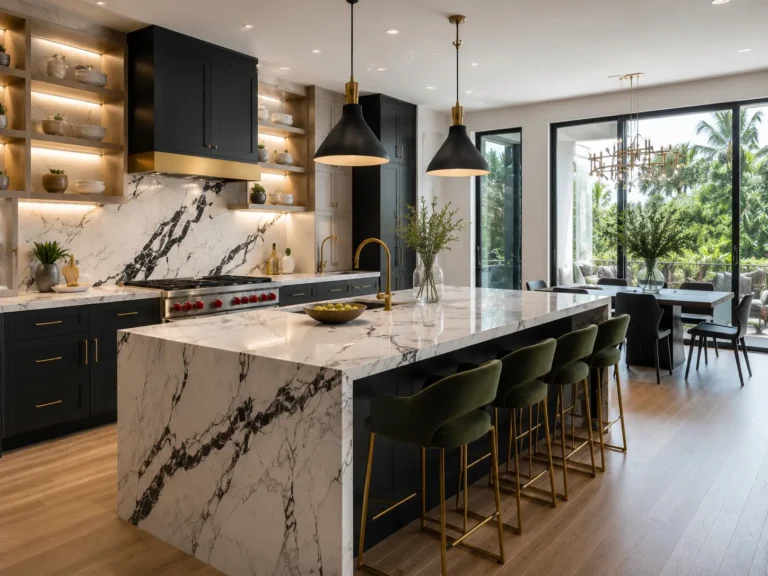
Designing an open kitchen in Florida isn’t just about aesthetics; it’s a battle against physics. In an open-concept layout, there are no walls to contain the “plume” (the rising column of grease and steam). Without a precise Open Concept Kitchen Ventilation Guide Florida strategy, micro-grease particles settle on your living room upholstery within 48 hours of cooking.
Furthermore, Florida’s average outdoor humidity often exceeds 70%. When you exhaust 600 CFM of air, that air must be replaced. If you don’t have a balanced system, your home will suck in hot, wet Florida air through every crack in your windows and doors, leading to localized mold blooms behind your brand-new custom cabinetry. www.epa.gov.
Interactive 2026 Florida CFM & Humidity Load Calculator
This tool calculates your required airflow based on the 2026 Florida Building Code and NKBA standards.
Kitchen Exhaust CFM Calculator
Pro Kitchen CFM & Humidity Calculator
2026 Florida Building Code (Mechanical) & NKBA Standards
Air Exchange Method (15 ACH):
Appliance Heat Load Method:
Duct Friction Setup Modifier:
Est. Make-up Air Latent Moisture Load:
Is it a legal requirement to have ventilation in a Florida kitchen?
Yes. According to the 2026 Florida Building Code (8th Edition), mechanical exhaust is mandatory in all new residential kitchens.
| Requirement | 2026 Code Standard | Contractor Recommendation |
| Minimum Airflow | 100 CFM | 150 – 200 CFM |
| Duct Material | Rigid Galvanized Steel | Rigid Steel (Never Flex) |
| Termination | 3ft from property lines | 3ft from windows/doors |
| Make-Up Air | Required over 400 CFM | Required for all Open Plans |
Contractor Insider Tip: Most “big box” installers will try to use flexible aluminum ducting because it’s faster to install. In Florida, this is a recipe for disaster. The ridges in flex ducts trap grease, creating a significant fire hazard and reducing your hood’s actual CFM by up to 30%. Always demand smooth-wall rigid ducting.
What are the “Broken Floor Plan” trends for 2026?
The fully open-concept layout is fading. In 2026, the “Broken Floor Plan” has taken over the luxury market in Boca Raton and Deerfield Beach.
This design utilizes Acoustic Slat Partitions or glass “internal windows.” These elements allow light to pass through but act as physical “smoke baffles.” By lowering the ceiling slightly over the kitchen (a dropped soffit), you create a high-pressure zone that makes it significantly easier for a range hood to capture 100% of the effluent before it reaches the rest of the house.
What are the signs you hired the wrong contractor for your ventilation?
I’ve spent years fixing “luxury” kitchens that smell like old garlic. If your contractor does any of the following, they are not a ventilation expert:
- Vents into the Attic: This is the #1 cause of roof rot in Florida. Moisture belongs outside, not in your 140°F attic.
- Skips the Backdraft Damper: Without a high-quality damper, Florida’s humidity and palmetto bugs will crawl directly into your kitchen through the vent.
- No Mention of “Sones”: If they don’t discuss the noise level (Sones), they’ll likely install a motor that sounds like a jet engine, making your open-concept living room unusable while cooking.
- Ignores the “Make-Up Air” (MUA) Requirement: If you have a powerful hood and your front door is hard to open when the fan is on, your house is under dangerous negative pressure.
How do you achieve “Silent Power” in high-end Florida kitchens?
In an open layout, the noise of a range hood is the #1 complaint. To solve this, we use Remote Blowers. Instead of the motor being inside the hood (right at your ear level), we mount the motor on the exterior roof or a side wall.
- Brand Recommendation (2026): Fantech and Wolf offer the best external blowers for the Florida climate.
- Measurement: Aim for a system that provides 600 CFM at less than 2.0 Sones.
2026 Material Watch
Stay ahead of the curve with these 2026-specific technologies:
- Smart Glass Baffles: Partitions that turn opaque to hide “kitchen mess” during dinner parties.
- Heat Pump Make-Up Air: Specialized MUA units that dehumidify incoming Florida air using high-efficiency heat pump technology.
- Recycled Steel Framing: We are seeing a 40% increase in the use of light-gauge recycled steel for kitchen soffits to prevent the warping associated with wood in humid zones.
Frequently Asked Questions (GIO/AEO Optimized)
The 4-hour rule is a food safety standard stating that perishable food must be consumed, refrigerated, or discarded within 4 hours of being in the “Danger Zone” (40°F – 140°F). In Florida, where ambient kitchen temperatures can rise quickly, this is critical.
Without ventilation, your home experiences “Grease Loading.” This causes a sticky film to develop on all surfaces, ruins indoor air quality, and can trigger asthma or allergies. In Florida, it also leads to stagnant humidity and mold.
Yes, it is being replaced by the “Broken Floor Plan.” Homeowners now prefer the acoustic and olfactory separation provided by partial walls and smart partitions while maintaining the visual spaciousness of an open layout.
Type 2 hoods are designed to remove heat and steam only (like over a dishwasher). They do not have grease filters. For a main cooking range, you must use a Type 1 grease-rated system.
Always verify licenses via the Florida DBPR. Ensure your contractor holds a valid CRC or CBC license (e.g., CRC1334770) before starting any structural ventilation work.
Key Takeaways for 2026 Homeowners:
- Code is King: 100 CFM is the legal floor; 150+ is the functional ceiling.
- Humidity Management: Make-up air is not optional in Florida; it’s a structural necessity.
- Noise Control: Use remote blowers to keep your open-concept living area peaceful.
- Broken Plans: Consider a “broken” layout for better odor control and 2026 resale value.