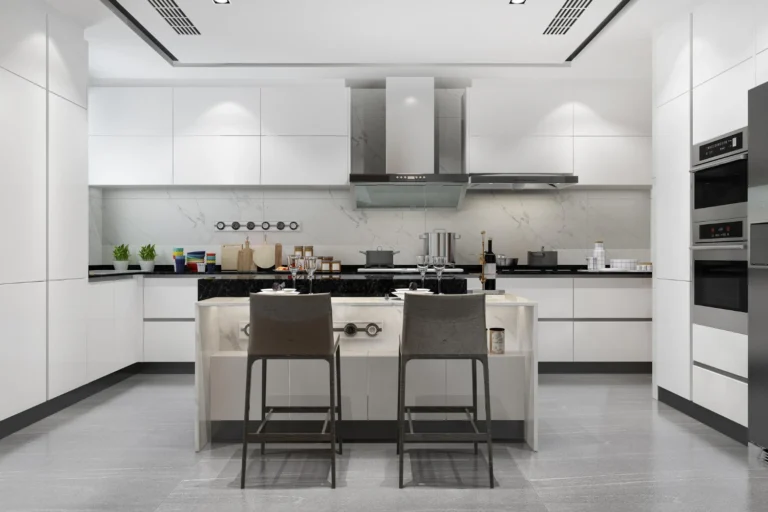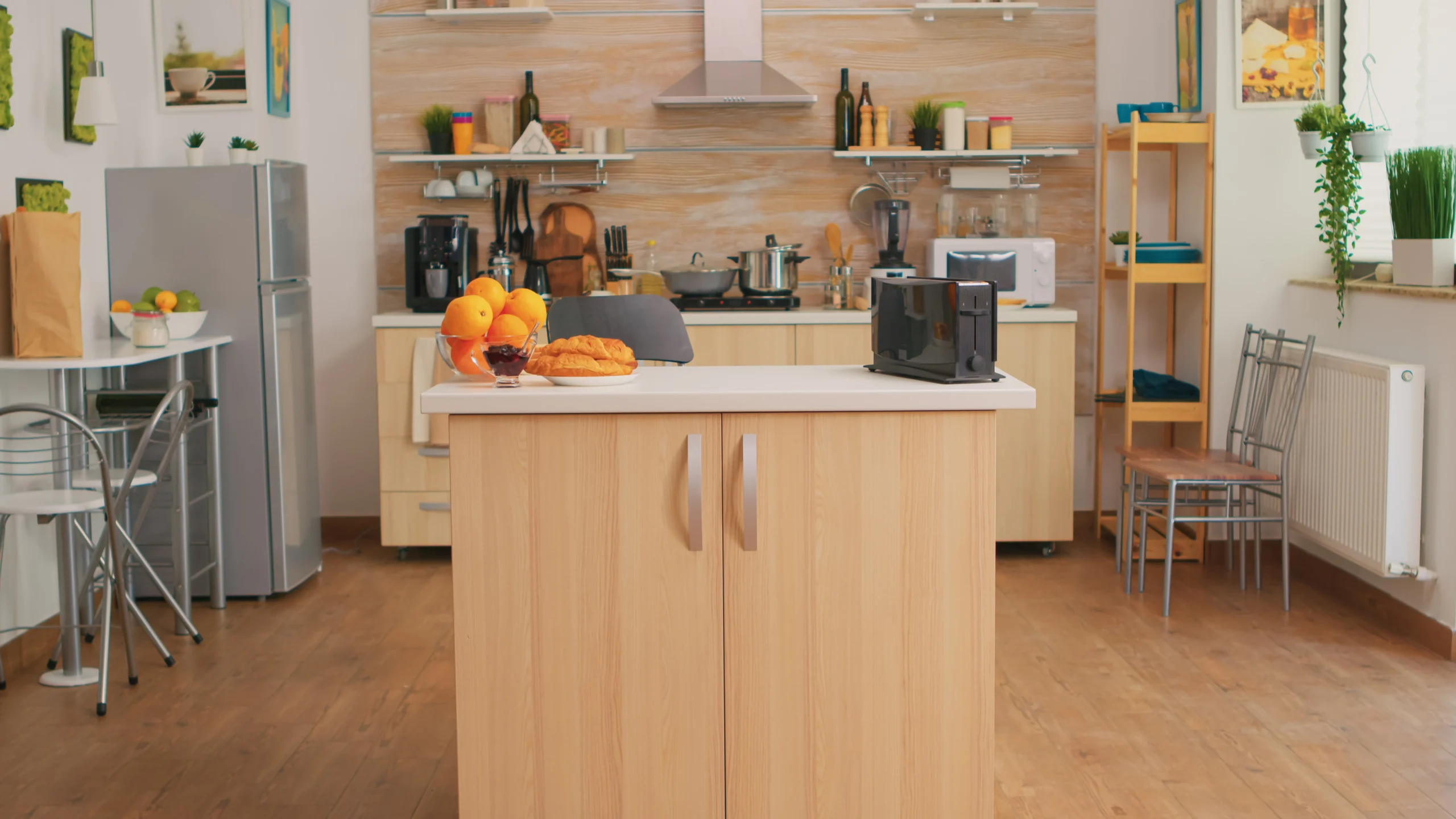
Open Concept Kitchen Remodeling in Boca Raton, FL (Costs, Pros & Cons, Permits)
You finally decide to knock out that wall between your kitchen and living room. The contractor gives you a quote. You feel excited. Three weeks into the project, you find out the wall is load-bearing, the HVAC duct runs through it, and your Palm Beach County permit is still in review. Now you are living off takeout and the remodel is 40% over budget.
That scenario plays out more often in Boca Raton than most contractors will admit to you at the first consultation. Open concept kitchen remodeling is genuinely one of the best investments you can make in a South Florida home. But it is also one of the most misunderstood projects in residential renovation. The lifestyle image — sunlight flooding across a gleaming island, guests mingling while dinner simmers, the whole downstairs feeling like one connected space — is real. The path to that lifestyle, however, involves structural engineering, Florida building codes, humidity-resistant materials, and a few decisions that will either make you love your kitchen for twenty years or quietly regret it every single morning.
This guide gives you the complete, unfiltered picture. Not the polished sales pitch. The actual information you need to make a smart decision for your Boca Raton home.
Who Will Benefit Most From Reading This Guide
Before you read further, check whether this applies to you:
- Homeowners in Boca Raton, Delray Beach, or Palm Beach County planning a kitchen renovation and researching open concept layouts
- First-time remodelers who want to understand what wall removal actually involves before hiring a contractor
- Sellers and house flippers trying to understand whether an open concept conversion adds enough resale value to justify the cost
- Existing open concept kitchen owners who are experiencing noise, smell, or design challenges and want solutions
- Anyone who has received a contractor quote for wall removal and wants to understand what is included and what is being left out
What Is an Open Concept Kitchen, Really?
An open concept kitchen removes the walls that separate the cooking area from the adjacent dining or living spaces, creating one continuous, connected room. That sounds simple until you realize that most of those walls contain electrical wiring, plumbing vents, HVAC ductwork, and in many cases, load-bearing structural elements that hold your home together.
In Boca Raton specifically, most homes built between the 1970s and 1990s — which covers a large portion of the housing stock in communities like Boca West, Broken Sound, and the streets east of Federal Highway — were designed with compartmentalized kitchens. The reasoning was practical at the time: closed kitchens contain smells, noise, and heat from the cooking area. Today, that reasoning has shifted. Buyers and homeowners want connection, light, and a kitchen that participates in the social life of the home rather than hiding from it.
The result is that open concept conversions in Boca Raton have become one of the most requested remodeling projects contractors receive calls about. The challenge is that not every home is equally suited for the conversion, and the cost and complexity vary more than most online guides let on.
The Real Benefits of Open Concept Kitchens in South Florida
1. Natural Light Becomes a Shared Resource Across the Whole Floor
Boca Raton has roughly 234 sunny days per year. A closed kitchen with one small window above the sink captures almost none of that. When you remove the wall between the kitchen and a south or east-facing living area, light from multiple windows and sliding glass doors floods across both spaces. The entire floor plan feels larger, brighter, and more connected to the outdoor environment that makes South Florida living worth the real estate prices.
This is not a minor aesthetic improvement. Natural light in the kitchen reduces your reliance on overhead artificial lighting during the day, lowers your electric bill over time, and creates the kind of atmosphere that makes cooking feel less like a chore and more like an enjoyable part of the evening. In homes with a pool deck or covered lanai, an open layout creates a nearly seamless visual transition from inside to outside — a design characteristic that South Florida buyers consistently rank among the top features they want in a home.
2. It Changes How Your Family Actually Uses the Space
Here is the honest truth that most design blogs bury three paragraphs in: open concept kitchens do not just look better, they change behavior. When the kitchen is visible and connected to where the family gathers, whoever is cooking does not become isolated from the household. You can supervise kids doing homework at the dining table while finishing dinner. Guests naturally drift toward the kitchen island and the conversation flows across the cooking and living areas without anyone having to shout through a doorway.
For families with young children — a large segment of Boca Raton homeowners — this supervisory benefit alone makes the conversion worth serious consideration. Parents who have completed the conversion consistently describe it as one of the changes that had the most impact on daily home life, not just the aesthetics.
3. It Adds Measurable Resale Value in Palm Beach County
Open floor plans are the most requested feature among home buyers in competitive South Florida markets. Real estate agents working the Boca Raton, Delray Beach, and Boynton Beach corridors consistently report that homes with open kitchen-living layouts sell faster and attract more offers than comparable closed-layout properties. The perceived square footage effect is real: a 2,000 square foot home with a connected kitchen-living area feels like 2,400 square feet to a buyer walking through it because their eye can measure the full depth of the floor plan in a single sightline.
In 2026, the ROI for minor to mid-range kitchen remodels in the South Atlantic region has actually ticked up slightly to 72% – 83% because buyers are now prioritizing “move-in ready” homes more than ever due to high interest rates. In premium zip codes like 33496 or 33434 in Palm Beach County, that number often runs higher because buyers at those price points actively expect open layouts and discount properties that lack them.
Open Concept vs Closed Kitchen: Which Is Better in Boca Raton?
| Factor | Open Concept Kitchen | Closed Kitchen | Best Choice for Boca Raton |
|---|---|---|---|
| Natural Light | Shares light from multiple windows and sliding doors across the entire floor | Limited to windows within the kitchen walls only | ✅ Open Concept — maximizes South Florida sunshine |
| Indoor-Outdoor Flow | Creates seamless visual connection to lanai, pool deck, and outdoor living areas | Disconnected from outdoor spaces; no visual continuity | ✅ Open Concept — essential for Florida lifestyle |
| Entertaining & Socializing | Host stays connected with guests; kitchen becomes the social hub | Cook is isolated from guests; conversations interrupted | ✅ Open Concept — ideal for Boca Raton’s active social culture |
| Cooking Odor Control | Smells travel freely into living and dining areas; requires high-CFM exhaust hood | Contains odors within the kitchen; easier to ventilate | ✅ Closed Kitchen — especially for aromatic South Florida cuisine |
| Noise Management | Dishwasher, exhaust fan, and disposal noise spreads throughout the home | Appliance noise stays contained within the kitchen | ✅ Closed Kitchen — better for work-from-home households |
| Storage Space | Loses upper cabinet runs when walls are removed; requires creative island and pantry solutions | Full perimeter wall space available for upper and lower cabinets | ✅ Closed Kitchen — more cabinet square footage by default |
| Resale Value in Palm Beach County | Open floor plans are the #1 requested feature by buyers; homes sell faster and attract more offers | Less attractive to modern buyers; may require price concessions in competitive listings | ✅ Open Concept — clear advantage in Boca Raton’s real estate market |
| Remodeling Cost | $55,000–$120,000+ for full conversion including structural work, permits, and new finishes | $25,000–$65,000 for a full refresh with no structural changes | ✅ Closed Kitchen — significantly lower investment |
| Permit Requirements (Florida) | Requires building, electrical, plumbing, and structural permits; Palm Beach County review takes 2–4 weeks | Minor remodels may avoid structural permits; faster project start | ✅ Closed Kitchen — simpler permit process |
| Hurricane Wind Load Engineering | Load-bearing wall removal requires Florida-licensed structural engineer to meet high-velocity wind zone codes | No structural changes means no hurricane load engineering required | ✅ Closed Kitchen — avoids complex Florida structural requirements |
| Humidity & Material Demands | Cooking moisture spreads across larger area; requires moisture-resistant cabinetry, quartz countertops, and sealed flooring throughout | Moisture stays more contained; standard material grades often sufficient | ✅ Closed Kitchen — less demanding on material specifications |
| Design Maintenance | Kitchen always visible; requires consistent, high-standard aesthetics and daily tidiness | Clutter and mess easily hidden behind closed walls | ✅ Closed Kitchen — more forgiving for busy households |
| Child Supervision | Full sight lines to living and dining areas while cooking; ideal for families with young children | No visibility to adjacent rooms; children out of sight while cooking | ✅ Open Concept — strong advantage for Boca Raton families |
| HOA Approval (Gated Communities) | Structural changes require HOA architectural review in communities like Boca West and St. Andrews; adds 3–8 weeks | Cosmetic remodels typically bypass HOA architectural review | ✅ Closed Kitchen — fewer HOA hurdles in gated Boca Raton communities |
| Best Fit For | Entertainers, families with young children, sellers targeting Palm Beach County buyers, homes with south/east-facing windows | Work-from-home households, frequent aromatic cooks, multi-generation families, condo owners with structural restrictions | Depends on your lifestyle — not a one-size answer |
The Drawbacks Competitors Do Not Talk About Honestly
Here is where most blog posts go soft. They list “potential cons” in a way designed to reassure rather than inform. This section will not do that.
1. Cooking Smells Travel Everywhere — and in Florida Heat, That Matters More Than You Think
An open concept kitchen means that when you sear fish at 450 degrees, the entire downstairs smells like seared fish for two hours. In a closed kitchen, your range hood captures most of that. In an open layout, a standard range hood handles a fraction of it, and the rest drifts into the living room, settles into upholstered furniture, and becomes part of the ambient smell of your home.
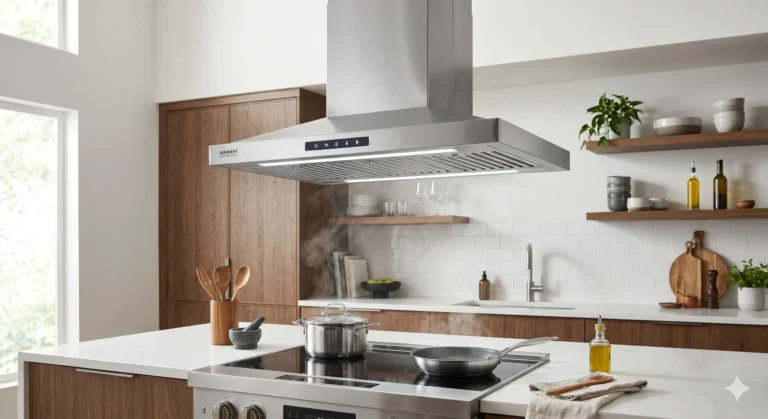
The solution exists — it is a high-CFM commercial-grade range hood ducted directly to the exterior, combined with a recirculating unit for the island if you have one. Brands like Zephyr, Broan, and Wolf make units designed for open concept kitchens. Expect to spend $800 to $3,500 on the hood itself, plus $400 to $1,200 for proper exterior ducting in a South Florida home. That cost is almost never included in the initial contractor quote for the open concept conversion. If you cook fish, garlic, or high-heat proteins regularly, this is not optional. It is the single most overlooked practical consideration in every open concept kitchen conversion I have seen go sideways.
2. Noise Distribution Is a Genuine Daily Quality-of-Life Issue
The dishwasher runs. The exhaust fan hums. The garbage disposal grinds for fifteen seconds at 7 AM on a Saturday. In a closed kitchen, none of that reaches the living room. In an open concept layout, all of it does. For households where someone works from home in an adjacent room, where there are young children who nap in the afternoon, or where one partner has a different morning schedule, this matters more than you will anticipate before the renovation.
Acoustic mitigation strategies that work well in Boca Raton homes include island placement that creates a partial sound buffer, strategic use of upholstered furniture near the kitchen boundary, heavy window treatments that absorb sound, and appliance selection that prioritizes quiet operation. The Bosch 500 Series dishwasher, for example, operates at 44 decibels — barely audible in an open layout. Less expensive dishwashers run at 55 to 60 decibels, which is clearly noticeable from a sectional sofa twelve feet away.
3. Storage Gets Sacrificed Unless You Plan for It Aggressively
A wall holds cabinets. Remove the wall and you lose the upper cabinet run attached to it. In a 200 square foot kitchen with a standard 10-foot cabinet run on the wall you are removing, you lose somewhere between 40 and 60 linear inches of upper storage. Most open concept conversions do not replace that storage adequately unless the designer specifically plans for it.
Solutions include floor-to-ceiling cabinetry on the remaining walls, a deeper island with full base cabinet storage on both sides, a walk-in pantry if the floor plan permits one, and dedicated appliance garages that keep the countertop clear. If your current kitchen storage is already tight, do not enter the open concept conversation without a detailed storage plan that accounts for what you are losing. This is the second most common source of post-renovation regret.
4. The Design Burden Shifts Entirely to You
Closed kitchens are forgiving. The walls contain the mess, the appliances, the visual noise. In an open concept layout, the kitchen is always on display. If your cabinets are mismatched, your appliances are dated, or your island does not have comfortable seating, that is visible from every corner of the living and dining area at all times. The aesthetic standards for open concept kitchens are genuinely higher than for closed ones because there is nowhere to hide.
This is not a reason to avoid the conversion. It is a reason to complete it properly. Budget for the full visual package — cohesive cabinetry, a countertop material that coordinates with the living space finishes, island lighting that functions as both task and ambient illumination, and flooring that reads well across both zones.
2026 Open Concept Remodeling Cost Guide: Boca Raton & Palm Beach County
2026 Open Concept Remodeling Cost Guide: Boca Raton & Palm Beach County
| Project Element | 2026 Boca Raton Avg. Cost | Why it costs more in FL |
|---|---|---|
| Structural Beam | $10,500 – $30,000 | Must meet High-Velocity Hurricane Zone (HVHZ) wind load engineering. |
| High-CFM Hood | $1,850+ (Installed) | Critical for preventing odors from circulating through the AC system. |
| Permit Fees | $500 – $3,000 | Includes Palm Beach County structural, electrical, and plumbing impact fees. |
| Quartz Countertops | $85 – $150 /sq. ft. | Preferred for non-porous performance in humid subtropical climates. |
What an Open Concept Kitchen Conversion Actually Costs in Boca Raton
This is where most competitors give you a useless national average and move on. Here is what the numbers actually look like in Palm Beach County in 2026.
Wall removal (non-load-bearing, no utilities):Change from “$1,500 – $4,000” to $2,000 – $5,500. (Disposal and patching labor have spiked).
Wall removal (load-bearing wall, requiring beam installation): Change from “$8,000 – $25,000” to $10,500 – $30,000+. Structural engineer consultation alone Change from “$400 – $1,200” to $650 – $1,800.
HVAC rerouting (ductwork that runs through the wall): $1,500 to $5,000 per trade
Electrical rerouting (outlets, switches, and circuits in the wall): $1,000 to $3,500
Plumbing relocation (if a sink or dishwasher line runs through the wall): $2,000 to $6,000
Full open concept kitchen remodel including new cabinetry, countertops, island, appliances, lighting, and flooring: $68,000 to $145,000 in the Boca Raton market, depending on finish level and scope
Permits: Florida Building Code requires permits for any structural changes, electrical work, plumbing updates, or wall removal. In Palm Beach County, permit fees typically range from $200 to $2,500 depending on scope, with review timelines of two to four weeks. Skipping permits is a serious mistake in Florida — unpermitted structural work must be disclosed at sale, can void homeowner’s insurance, and can require you to open walls and redo work before a property changes hands.
Always budget an additional 10% to 20% as a contingency. In South Florida homes, contractors routinely discover mold, outdated aluminum wiring from the 1970s, or asbestos in popcorn ceilings once demolition begins. These are not rare exceptions — they are regular occurrences in Boca Raton’s older housing stock.
The Florida-Specific Factors That Most National Guides Completely Ignore
Hurricane-Code Structural Requirements in Palm Beach County
Florida is not like other states when it comes to structural modifications. Palm Beach County falls under the Florida Building Code, which is among the most stringent in the country specifically because of hurricane load requirements. When a load-bearing wall is removed and replaced with a beam, that beam must be engineered to handle not just the vertical dead and live loads of the structure above it, but also the lateral wind loads prescribed for South Florida’s high-velocity hurricane zone.
This means your structural engineer cannot simply spec a standard LVL beam and call it done. The calculations need to account for Category 4 and 5 wind pressures. The posts at either end of the beam need to transfer those loads all the way down to the foundation. An engineer who is not familiar with Florida’s specific wind load zones may undersize the structural components, which creates a code compliance problem and, more importantly, a safety issue. Always verify that your structural engineer is licensed in Florida and has active experience with Palm Beach County projects.
Humidity and Material Selection for Open Kitchens in South Florida
A closed kitchen manages humidity somewhat by containing cooking steam. An open kitchen distributes that moisture across a larger area. In Boca Raton’s humid subtropical climate, this has practical consequences for material selection that most national remodeling guides skip entirely.
For cabinetry, avoid particle board cores in any open concept kitchen in South Florida. Moisture infiltration causes delamination, swelling, and cabinet failure over time. Specify plywood box construction with a factory finish or, better, MDF-core doors with a moisture-resistant coating. For countertops, quartz outperforms marble and granite in humid environments because it is non-porous and does not absorb cooking moisture or condensation. Engineered hardwood handles South Florida humidity better than solid hardwood for flooring, but luxury vinyl plank with a full waterproof core is the most durable option in kitchens that see heavy daily use.
HOA and Building Approval Requirements
Many Boca Raton communities — including the gated developments of Woodfield Country Club, St. Andrews Country Club, and Boca West — require HOA architectural review and approval before any interior remodel that involves structural changes can begin. HOA approval does not replace the city permit requirement. You need both, and the HOA approval process can add three to eight weeks to your project timeline depending on the community’s review schedule. Factor this into your planning before signing a contractor agreement with a start date.
Who Should Actually Do an Open Concept Kitchen Conversion in Boca Raton
Not every household or home is the right fit for this project, and the honest answer is that contractors rarely tell you when it is not the right fit for you because they want the job.
Strong candidates for open concept conversion:
- Families with children under 12 who want supervisory sight lines from the kitchen to living areas
- Active entertainers who host regularly and want the kitchen to function as part of the gathering space
- Homeowners planning to sell within 3 to 7 years who want maximum resale appeal in the Boca Raton market
- Homes with closed kitchens adjacent to a living or dining area with a south or east-facing window wall that would contribute significant natural light to the combined space
Poor candidates who should reconsider or pursue a different solution:
- Households with a dedicated home office adjacent to the kitchen, where appliance noise will interfere with work
- Multi-generation households where different people keep very different schedules
- Anyone who cooks aromatic or high-heat cuisine daily and does not want to invest in a high-CFM exterior-vented range hood
- Homes where the structural assessment reveals a particularly complex load path that makes the beam engineering extremely expensive relative to the square footage gained
- Condo owners who need to navigate both HOA approval and building structural reviews before any wall removal
A semi-open concept — using a half-wall, peninsula, or strategic island placement to create visual openness without full structural removal — is a legitimate, often better alternative for households that want the light and connection without the full commitment.
How to Find the Right Contractor for This Project in Boca Raton
The open concept kitchen conversion touches structural engineering, framing, electrical, plumbing, HVAC, cabinetry, countertops, flooring, and finish work. That scope requires a licensed general contractor, not a kitchen design firm that subcontracts construction, and not a single trade specialist who manages scope creep informally.
In Florida, verify that your contractor holds a state Certified General Contractor (CGC) license. You can check this on the Florida Department of Business and Professional Regulation’s license lookup tool at myfloridalicense.com. Ask for their CGC number in the first conversation. A contractor who hesitates to provide it is a contractor you should not hire for a project of this scope.
Ask specifically:
- Who pulls the permits, and in whose name?
- Do you carry general liability insurance and workers’ compensation in Florida?
- Have you completed structural wall removal projects in Palm Beach County in the last 24 months? Can I speak with those homeowners?
- Who is your structural engineer, and what is their experience with Florida wind load requirements?
- What is your process when you discover unexpected issues during demolition?
Get at least three written, line-item quotes. The lowest quote is rarely the best one — in Boca Raton’s construction market, it often means the contractor is planning to cut corners on permitting, structural engineering, or material quality. The difference between a $58,000 quote and an $80,000 quote usually lives in the structural work, the cabinetry quality, and whether the contractor is properly insured and permitted.
The Hybrid Approach: Open Concept Benefits Without Full Commitment
Here is a perspective that very few contractors will volunteer because it means a smaller project scope: you can capture most of the practical benefits of an open concept kitchen without removing a single load-bearing wall.
A large cased opening (essentially a widened doorway, 6 to 8 feet wide) between the kitchen and living area maintains structural integrity while dramatically improving light flow and visual connection. A pass-through window or counter from the kitchen into the dining area creates service connectivity without a full conversion. A peninsula that replaces a partial wall creates seating, prep space, and visual openness while retaining the sound and smell containment of a partial barrier.
In homes where the structural conversion would be extremely expensive due to complex load paths, or where the homeowner genuinely wants some acoustic separation, these hybrid approaches often produce 80% of the result for 40% of the cost. The key is designing them intentionally rather than settling for them by default.
Frequently Asked Questions About Open Concept Kitchen Remodeling in Boca Raton
Do I need a permit to remove a kitchen wall in Boca Raton, FL?
Yes. Under the Florida Building Code, any wall removal — load-bearing or not — that involves structural, electrical, plumbing, or HVAC changes requires a permit from Palm Beach County. Even cosmetic-seeming alterations may trigger permit requirements if they affect systems behind the wall. Unpermitted structural work creates disclosure obligations at sale, can void insurance claims, and may require expensive remediation. Never let a contractor talk you into skipping permits in Florida.
How long does an open concept kitchen remodel take in Boca Raton?
A full open concept kitchen remodel — including structural work, new cabinetry, countertops, appliances, and finishes — typically takes 8 to 14 weeks from permit approval to final inspection. Add 2 to 4 weeks for permit review and 4 to 12 weeks for custom cabinet lead times. Total project duration from initial consultation to finished kitchen commonly runs 5 to 7 months when custom cabinetry is involved. Contractors who promise you a 6-week turnaround on a full conversion are either underestimating the scope or planning to cut corners.
Will removing a wall in my Boca Raton home require a structural engineer?
Almost certainly yes, if the wall is load-bearing. Florida’s hurricane wind load requirements mean that beams spanning large openings must be engineered specifically for Palm Beach County’s high-velocity wind zone. Your general contractor should coordinate the structural engineer as part of the project. If a contractor offers to remove a load-bearing wall without involving a structural engineer, walk away.
Does an open concept kitchen increase home value in Boca Raton?
Yes, meaningfully. Open floor plans are among the most requested features by buyers in Palm Beach County. Well-executed open concept kitchen conversions typically recoup 65% to 80% of their cost at resale in this market, and they can help homes sell faster and attract more competitive offers. The key qualifier is “well-executed” — a structural conversion that was done without permits, used low-quality materials, or failed to address the storage deficit it created will not deliver that return.
What is the biggest mistake homeowners make with open concept kitchen remodels?
Not budgeting for ventilation. Every experienced contractor in South Florida will tell you that the most common source of post-renovation complaint in open concept kitchens is cooking odors spreading through the living area. A properly sized, exterior-ducted range hood with at least 600 to 900 CFM of ventilation capacity is not optional in an open layout. Include it in your budget from the start, not as an afterthought once the countertops are installed.
Can I do an open concept conversion in a Boca Raton condo?
It depends heavily on your building. Condos require building structural approval in addition to city permits, and many high-rise and mid-rise buildings in Boca Raton prohibit removal of walls that are part of the building’s concrete or masonry structural system. HOA architectural review is also required. Engage your building management and review the condo declarations before you spend a dollar on design or contractor quotes.
How do I keep an open concept kitchen from looking messy all the time?
Design for concealment. Appliance garages that hide small appliances behind cabinet doors, deep drawers instead of standard shelving, a built-in pantry with closed doors, a large enough island to keep prep items off the countertop, and a consistent color and material palette that reads as intentional rather than accumulated. Open concept kitchens reward organized households and punish disorganized ones. That is not a design flaw — it is a design reality worth knowing before you commit.
What materials hold up best in an open concept Boca Raton kitchen?
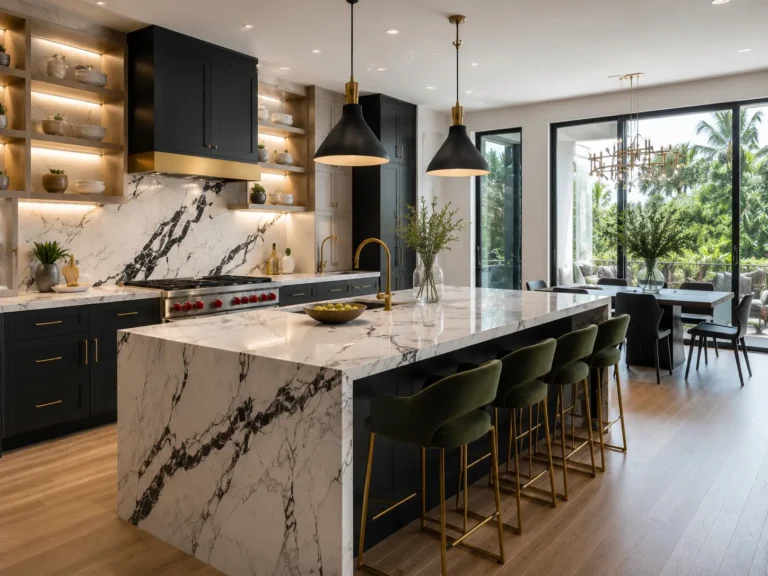
For Boca Raton’s humidity: quartz countertops (non-porous, low maintenance, consistent patterning), plywood-box cabinetry with moisture-resistant finish, and luxury vinyl plank or porcelain tile flooring. For appliances: stainless steel continues to dominate in open layouts because it reads consistently under varied lighting conditions and coordinates with most cabinet finishes. If you are investing in an island, a waterfall quartz edge — where the countertop material continues vertically down the island sides — has become the signature design choice in South Florida luxury kitchens and holds up exceptionally well over time.
The Honest Bottom Line for Boca Raton Homeowners
Open concept kitchen remodeling is one of the most impactful changes you can make to a Boca Raton home. It transforms how you experience the space, improves how natural light works throughout the main living floor, and creates a home that is genuinely better suited to the way South Florida households live — entertaining, gathering, watching the kids, connecting across the household.
It is also not the right project for every home, every household, or every budget. The structural complexity is real. The permit requirements in Palm Beach County are non-negotiable. The hidden costs — ventilation, HVAC rerouting, storage replacement — are consistently underrepresented in contractor quotes and online guides.
The homeowners who are happiest with the result are the ones who went in fully informed: they knew what the project would actually cost, they chose a licensed general contractor who pulled proper permits and used a Florida-licensed structural engineer, they budgeted for the range hood and the island storage and the new flooring transition, and they made a design decision that matched how their specific household lives — not just how open concept kitchens look in design magazines.
If you are still in the research phase, good. That means you are doing this right. The next step is getting two or three written, line-item quotes from licensed general contractors in Boca Raton who can assess your specific walls, your specific structural situation, and give you real numbers for your home rather than national averages that do not account for Palm Beach County’s permit requirements or South Florida’s humidity and wind load realities.
The kitchen is worth getting right. Take the time to do it properly.
Have a question about your specific Boca Raton home or a detail from this guide? Drop it in the comments below. Every home is different, and the specifics of your floor plan, your HOA, and your household’s daily life all matter when making this decision.